- writing date 2026.07.30
- author Communication Team
- hits 5
AKEO EDU CEO Kang Tae-hwan (Graduate School of Education, Computer Science Education, Incoming Class of 2022)
Helps Students Change

“Why doesn’t AI give me the answer?” We live in an era where it’s not just office workers and members of the general public who are used to easily getting answers from AI, but also elementary, middle, and high school students . The reason why I thought about a hint-giving AI in this situation was because I hoped that students would find answers on their own and internalize them. What Kang Tae-hwan, the CEO of edtech startup AKEO EDU, came up with while developing the AI-based coding training platform AKEO was not a teacher to provide immediate answers. Instead, he envisioned a type of quick-witted teaching assistant. He believed that developing this kind of AI model would foster students’ healthy growth using AI rather than seeing learners become consumed by it.
The Dream of Good Education Held by Chance
One day, a friend of Kang who majored in computer and information technology, offered him a job as an academy instructor. The friend planned to start a coding academy. That is how Kang began building experience in the field of education. “One of my middle school students told me that learning coding was so much fun that he decided to study a related field in college. I realized that I could influence someone’s future or dreams. Since then, I have worked harder with a greater sense of responsibility.” After spending five to six years in the field he had entered by chance, Kang began studying computer science education at the Graduate School of Education, led by a desire to become a better teacher.
A Clue to a Problem Encountered in Class
In the first semester of 2023, while I was learning about various application examples of generative AI, a hot topic at the time, in my Topics in Artificial Intelligence class taught by Professor Kim Hyun-cheol, I was reminded of the classroom where I used to teach coding. “When a teacher handles more than ten students, a bottleneck phenomenon occurs. While answering a student, others have to wait forever. Even a single incorrect dot can cause an error in coding, and when that happens, students feel at a loss as to what to do. I suddenly came up with an idea of employing AI for this situation. If AI plays a role as a teaching assistant, it would benefit both students and teachers by immediately providing answers and by letting them focus on each student without rushing, respectively. That is how I started developing an AI-based coding training platform, and one year later, in January 2024, I founded AKEO Edu.
Agentic AI: A Quick-witted Teaching Assistant
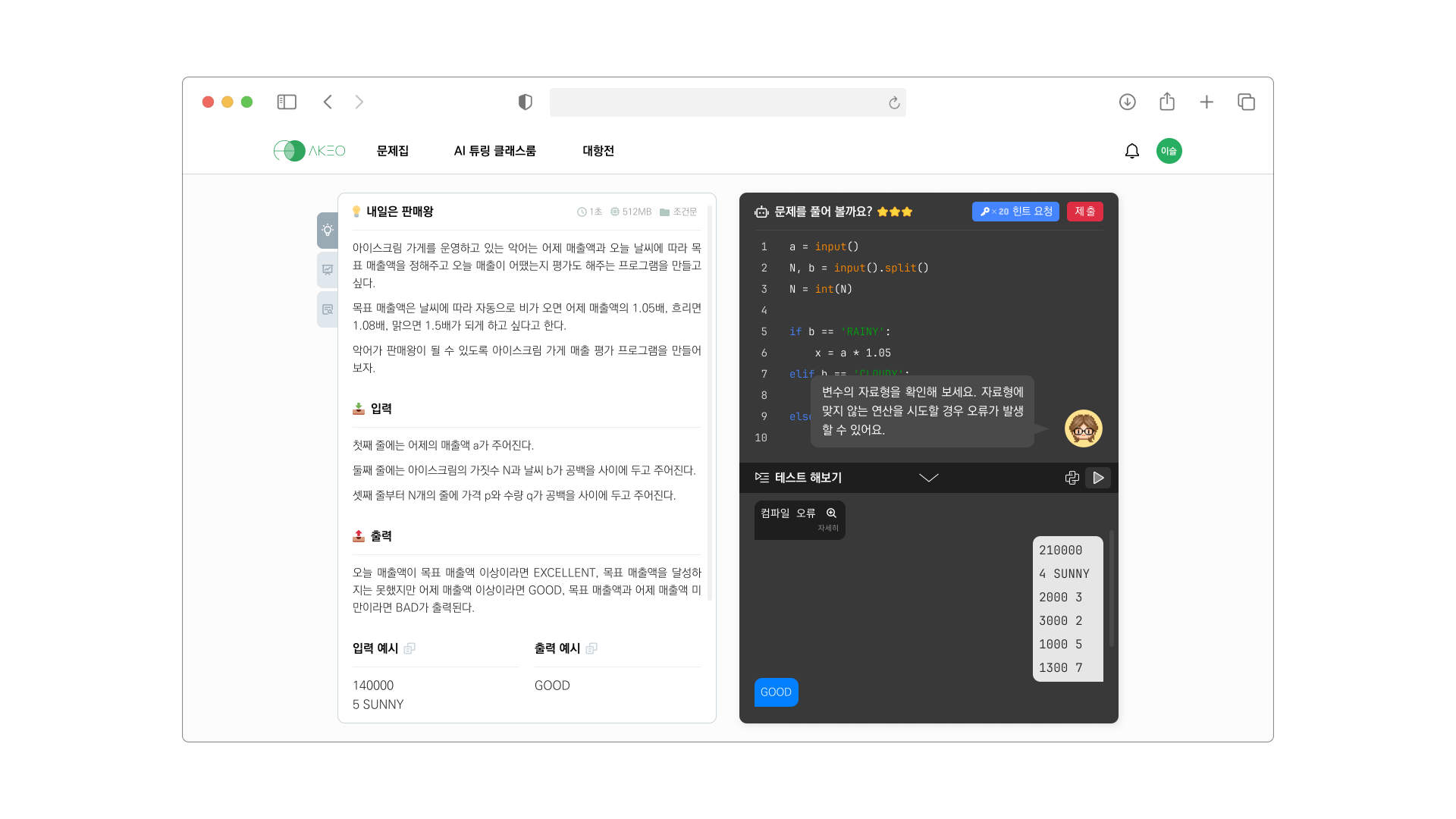
How should we apply Agentic AI, which performs tasks more autonomously, to the educational field? Kang thought that it was necessary for the AI to understand students’ learning state before listening to their questions. After identifying patterns where students hesitate or write and delete code while solving problems, by providing appropriate hints, AI can help students figure out problems on their own. With this goal, he developed an AI that provides hints rather than direct answers. “If we look at the answer key immediately when stuck on a math problem, we could finish the homework quickly, but most of us won’t be able to solve it on our own later. This happens due to the illusion of competence, a wrong belief that the problem-solving process we just read through has become our actual skill. I thought that an AI tutor giving direct answers would lead to the same result.”
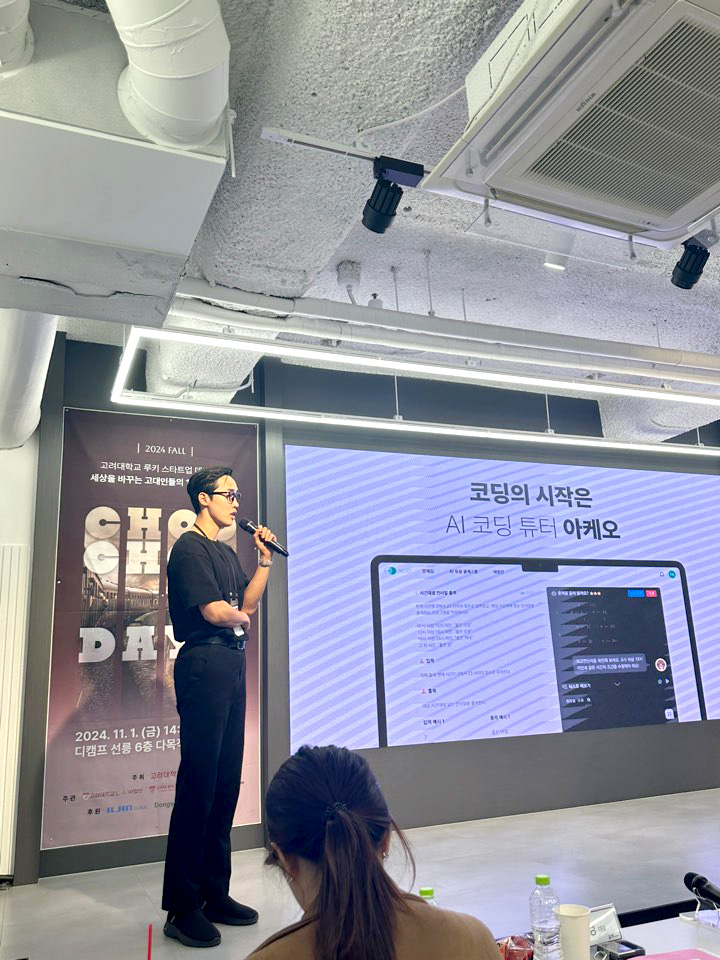
(Top) AKEO presentation
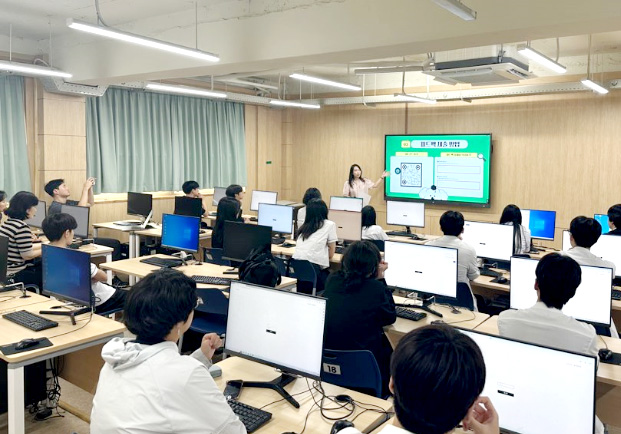
(Middle) AKEO-applied SW specialized high school classroom
(Bottom) AKEO AI tutor assisting students by providing hints
AI Hints: Small Sense of Achievement, Big Change
As the CEO of AKEO EDU, Kang is currently operating a coding academy to verify the effect of AKEO, an AI coding education platform developed by AKEO EDU, in order to apply it to the educational field. The AI-assisted hint system has brought positive effects. Reduced frustration and the small sense of achievement obtained from solving problems on their own has created significant, impressive changes in students.
After he introduced AKEO, we began to see a gradual change in the attitude of a student who had previously struggled with coding. With hints tailored to his skill level provided whenever he was stuck on problems, the student started finding the answers on his own by thinking things over instead of simply waiting for help or copying the answers. “As the experience of independent problem-solving accumulated, the student started visiting me without me calling him, asking “Mr. Kang, when can I solve the problems for the next level?” This student, who used to lack confidence in coding, is now waiting for the next stage. He developed a taste for coding and even went to a specialized software high school.”
Observing this process, I started to think more deeply about AI should be applied to the educational field, and became confident about its role as a pacemaker.
High Tech x High Touch
So does the introduction of an AI teaching assistant benefit only students? Kang explains that in fact, it serves as an opportunity for teachers to focus on real education. If AI takes charge of providing customized knowledge on a one-to-one basis, teachers can save physical time and energy. I hope that with the secured time and energy, they can fully focus on emotional and social education. The role as an emotional safety net for students off-screen, such as reading the e-x-p-r-e-s-s-i-o-n of a student who looks daunted today or mediating conflicts among students, is an area that AI cannot reach.
I believe that educational site in the era of AI is a combination of high-tech, which utilizes technology, and high-touch, which involves human interaction. Making eye contact with students, motivating them, and forming warm relationships are the unique roles of human teachers that AI cannot replace.

CEO and co-founder Kang Tae-hwan (left) persuaded his friend Kim Jun-kwon (right, current CTO), who was working in Silicon Valley, to launch AKEO EDU. They are running the company together.
We Must Endure the Discomfort of Asking Questions and Pondering
Based on his experience with AKEO, Kang explains that in order to maintain agency in the age of AI, we must endure the inconvenience of asking questions and pondering for ourselves. He says that this is because he realized that true growth is achieved when we try to find answers on our own through hints, instead of easily obtaining free answers. He also learned that helpful hints can always be found around you. When there was no market response during the first six months after starting the business, Kang wondered a little if he had taken the right path, but after selecting for the KU Campus Town project, he was able to learn things he did not know as an entrepreneur through expert mentoring and networking. In addition, thanks to the support from his advisor and unexpected help he received simply for being a KU alumnus, he was able to grow the business into a more solid one.
“In fact, it seems that everything that happens in the world arises from relationships between people. Even in an age of Agentic AI, creating new tasks, by empathizing and interacting with others, will remain a unique role exclusive to human beings.