- writing date 2026.07.30
- author Communication Team
- hits 4
LMNT Choe Jang-soon
(Department of Linguistics, Entering Class of 1998)
Building KRW 1 Trillion in Value
through Semiotic Branding
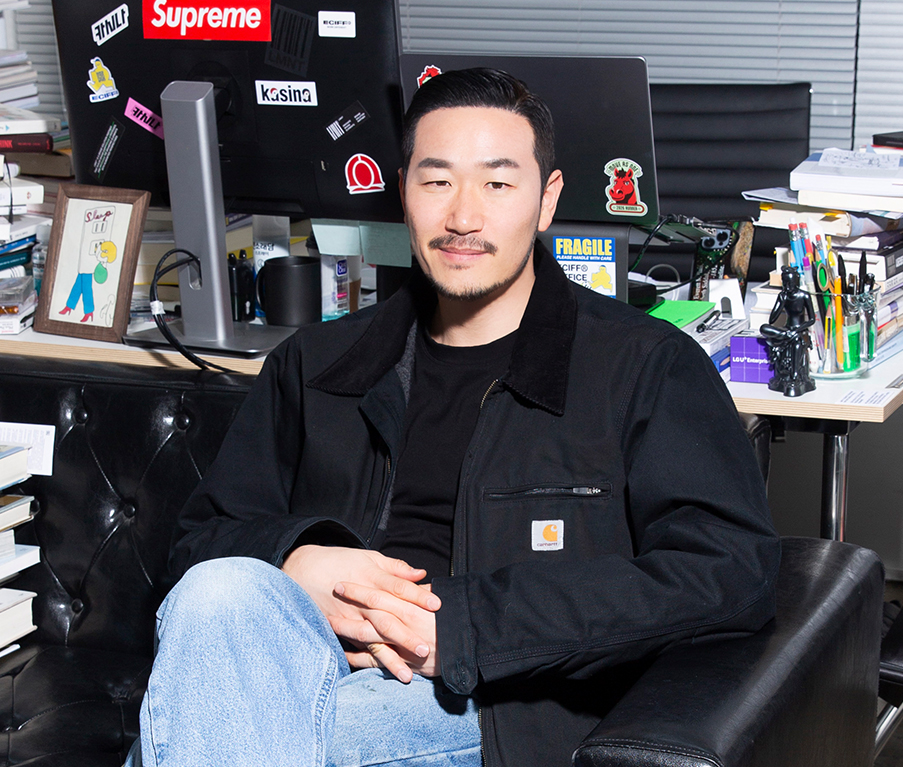
Samsung Galaxy, Krafton, Hyundai Motor, LG Uplus, TVING, Soomgo, Kakao, Lotte Duty Free, and Parata Air. These are just some of the companies that have entrusted their brands to Choe Jang-soon, CEO of lmntcompany. (“LMNT”). Through his work, familiar brands are reimagined with stronger philosophies, more compelling narratives, and distinctive visual identities. Having studied linguistics, philosophy, and semiotics at Korea University, Choe learned not simply how language works, but how people think. Earlier this year, his pioneering application of semiotic principles to business earned him the SEMA Award (Semiotic Excellence & Multidisciplinary Advancement Award) from the Asian Semiotics International Association (ASIA). He also serves as an adjunct professor in Korea University’s Department of Linguistics, where he teaches Applied Semiotics and continues to bridge academia and industry. In LMNT’s office, lined with carefully curated books and walls covered in colorful notes, we sat down with Choe to discuss the philosophy behind branding that creates lasting value.
College years: learning how to learn
Becoming a brand strategist was never Choe’s original ambition. As a high school student, he was fascinated by the relationship between religion and language. His desire to read the Bible in its original language and to understand the world more accurately through language led him to the Department of Linguistics at Korea University.
His memories of college are marked less by nostalgia than by perseverance. He remembers skipping meals and waiting near the campus convenience store for a senior student to pass by. At drinking gatherings, he would quietly take notes on his lap so he could follow what his seniors were saying. On nights when he missed the last bus home, he slept on campus benches wrapped in newspapers, waking only when the lights of Democracy Square came on.
He remembers that studying linguistics, philosophy, and semiotics was just as demanding. A turning point came in Professor Kim Sung-do’s class. “The lectures were incredibly difficult, but I kept attending, submitted every assignment, and eventually Professor Kim invited me to sit in on graduate-level courses during the first semester of my sophomore year. For about a year I took graduate-level courses. The workload was intense. We were expected to read an English-language book every week, along with roughly 100 pages each of German and French texts.”
Working through lectures that often felt impenetrable and assignments that demanded relentless effort, Choe came to realize that language does not merely reflect the world, but it actively shapes and reconstructs it. That realization would later become the intellectual foundation of his approach to branding.
A linguistics graduate’s journey into branding
After graduation, Choe’s career decision rested on a surprisingly simple principle. “I didn’t want everything I’d studied at university to go to waste. I had only one criterion: find a job where I could actually use my background in linguistics.” Such opportunities were scarce. Then fortune intervened. He came across a branding firm that was looking for linguistics graduates. “It was Brand & Company, one of the first companies in Korea to specialize in brand strategy. The firm was the exclusive Korean partner of Professor David Aaker of UC Berkeley, a pioneer in brand equity research. Fortunately, I was hired there as a naming specialist.”
Applying academic knowledge in a business setting, however, proved anything but straightforward. His background in linguistics allowed him to draw on fields such as phonetics and morphology, but some senior colleagues told him, “You’re simply not cut out for this,” or “You should just go to graduate school instead.” Undeterred, he approached branding through the lens of the humanities. In 2017, he founded LMNT, and since then the firm has led branding projects spanning Hyundai Motor’s R&D vision, airline brand development, AI initiatives, and numerous corporate identity projects.
“When we worked on Hyundai Motor’s R&D vision, I immersed myself in studying the future of mobility. At the time, Vice Chairman Chung Eui-sun personally unveiled the vision summarized by the slogan ‘Beyond the Car.’ It is a project I still remember vividly because company owners rarely step forward themselves unless the project is especially important. More recently, we developed the brand for Parata Air, a low-cost carrier, including the livery design for the aircraft’s wings and fuselage. The color palette was derived through ideas drawn from semiotics, Greek philosophy, Karl Marx, and Gilles Deleuze. It was an incredibly rewarding process. Every project, from Kakao AI Campus to Soomgo, has been meaningful in its own way.”
From KRW 200 billion to KRW 1 trillion: the power of branding in building corporate value
Choe’s approach to branding is grounded in rigorous structural thinking and contextual analysis. While many companies compare the pros and cons of potential names when deciding on a brand name, he first considers the context in which the name will be communicated and the direction in which it should evolve. He considers the consumer environment, commercial context, psychological theory, and the unique space and narrative the brand seeks to establish in the market.
One case, in particular, illustrates his philosophy. A technology company valued at around KRW 200 billion once introduced itself as a “camera recognition technology company.” LMNT concluded that the description failed to fully convey the company's value in the marketplace. Instead, the firm redefined the business as a “vision AI company” and overhauled its website and messaging accordingly. Under its new identity, the company began communicating its value more proactively, and today it is valued at approximately KRW 1 trillion.
“That’s the power of language.” For Choe, branding goes far beyond packaging. “In branding, it’s about identifying a message that sits in the narrow space between aspiration and reality—one that is ambitious yet achievable.” He explained that the role of branding is to encourage companies to make that promise publicly and to move their business toward fulfilling it. “Even if a message is highly aspirational and difficult to put into practice right away, once it’s brought into the public sphere, it becomes much harder to ignore. Just as politicians face pressure to honor their campaign pledges, language becomes a mechanism that drives action.”


(Top) Group photo from a 2025 semiotics conference at the University of Turin. Choi presented practical applications of brand semiotics at a symposium alongside Professor Massimo Leone and Professor Kim Sung-do’s research team.
(Bottom) The development process for LMNT’s in-house officewear brand, Eciff®, in 2023. Choe developed the brand around an anagram derived from the word “office.”
“Anyone who continues to learn, questions familiar language,
and strives to produce better interpretations each day
is the planner of their own life.”
Winning over clients is another critical part of any branding project. For Choe, the starting point of persuasion is theoretical coherence. “Branding is ultimately a management discipline, so case studies certainly matter. But too often people stop at saying, ‘This worked elsewhere, so let’s do the same.’ They never explain why it makes sense in this particular context. I always start by establishing a coherent theoretical foundation.”
To illustrate his point, Choe cites the American philosopher and semiotician Charles Sanders Peirce. He explains that persuasion is ultimately about understanding the other person’s frame of reference. As Charles Sanders Peirce defined it, a sign is “something which stands to somebody for something,” with the important qualification “in some respect or capacity.” “Gold, for example, functions as money in one context and as a metal in another. The key to persuasion is understanding the context in which your language and the other person’s language are being used, and the capacity in which each is understood.”
To that end, Choe studies his clients’ areas of expertise and decision-making environment closely. This information helps him calibrate the nuance of his message. “Anyone can construct a theoretical argument. But in practice, ninety percent of persuasion comes down to nuance. Sometimes all it takes is the feeling that ‘This person is on my side.’ I often say that words have their own return on investment.”
More than flashy packaging: the power of narrative
Asked what distinguishes LMNT from other branding firms, Choe first points to its grounding in the humanities. The company regularly holds internal seminars and study sessions where employees reinterpret contemporary phenomena through the lenses of philosophy and semiotics.
“Every Monday morning, we have a company-wide meeting, and I often give a lecture. For example, I might say, ‘Let’s interpret the recent hit KPop Demon Hunters through Jean Baudrillard’s theory of simulacra.’ I explain my interpretation and the underlying concepts, then show how they could be applied to BX or UX design and what kinds of methodologies they might lead to. Then I gather feedback from my colleagues and apply those ideas to actual projects. It's not something many companies do.”
He also emphasized that what ultimately resonates with consumers is not a short-lived stimulus but a narrative that can stand the test of time. The real question is not whether a design stands out or whether the copy sounds compelling, but whether it has a narrative that can endure for the next ten years. That is why LMNT looks beyond a company’s present. Instead, the team traces its genealogy—its founding values, the philosophies that have evolved across generations, and even chapters of its history that the organization might prefer to forget. When it can demonstrate that those past values continue into the present, even if they appear different on the surface, a brand earns deeper support.
Choe calls this process “semiotic reconciliation.” Even when a new generation of leaders wishes to distance itself from the values of its predecessors, it is far more persuasive to show that those values have not been abandoned but are simply being practiced in a different way. “We uncover the values embedded in a company’s history and philosophy, then weave them into a single thread. That’s something we’re particularly good at.”
In the In the end, what remains is meaning
As the interview drew to a close, we asked Choe what mattered most to him in life. The answer was brief. “Meaning.” Since discovering semiotics more than two decades ago, he has spent more than twenty years thinking about signification. He wonders why orthodontic braces have become symbols of wealth and a trendy lifestyle among young people in parts of Southeast Asia, or why suitcases are prominently displayed in the living rooms featured on Chinese social media to signal that their owners could leave at any moment. To most people, these may be ordinary scenes. To Choe, they are all signs embedded in cultural context.
Saying that he “no longer believes in anything that transcends the world,” Choe concluded that even if everything ‘disappears,’ the meaning of its disappearance remains. Ultimately, meaning is what matters most to him, and his work is about studying and creating meaning.
Rather than building an impressive résumé, he encourages his juniors to have what he calls “the experience of devouring a single book.” The experience of grappling with difficult texts, debating them, writing about them, and accepting criticism. That was what Choe learned during his college years, and what he has held on to throughout his career in branding. The world is shaped not only by objects, but by the language through which we interpret them, and by our willingness to engage with meaning.
SPECIAL
Branding Q&A with CEO Choe Jang-soon
Brands That Endure in the AI Era and How to Stay Human

Q1. What kinds of brands will endure in the age of AI?
A. I believe nearly every industry will become increasingly polarized into a U-shaped structure. On one end will be an efficiency-driven segment, where AI enables products and services to be created faster and more cheaply. On the other will be brands whose value lies in qualities that cannot be replicated. Take the automotive industry. Once autonomous driving becomes commonplace, vehicles designed simply for commuting will become increasingly commoditized, because all they need to do is get people from one place to another. But brands like Ferrari and Lamborghini will continue to thrive because they sell something entirely different: the joy of driving itself. That unique value, which comes only from driving the car yourself, may become even more valuable. The same principle applies to brands. To remain relevant, they must embody something that only humans can create, rather than relying solely on efficiency or functionality.
Q2. You view AI not as a threat, but as a tool and partner. How do you use it?
A. Very actively. I rely heavily on AI when I am studying or developing research models. In the past, designing a single brand equity model could have cost hundreds of millions of Korean won and required an enormous amount of time. Today, AI can bring together scattered validation data and produce a draft almost instantly. More importantly, however, I position AI as something that challenges me. As the CEO, I recognize that it is not easy for my colleagues to immediately disagree with me or point out flaws in my reasoning. Even when I say something nonsensical, they may simply step back and say, “I’ll give it some more thought.” AI has no such reservations. So I deliberately ask it to identify weaknesses in my reasoning or suggest entirely different possibilities. In effect, I have it serve as a “red team.”
Q3. What human capability will become even more important in the AI era?
A. An analog sensibility that cannot be put into words. When we encounter a person or a scene, we sometimes have an intuition that something feels off or that something is bound to succeed, even though we cannot explain why logically. This is a form of inexplicable big data that humans have accumulated at the cellular level over an immense span of time. Machines excel at processing vast amounts of information and producing the safest possible average. Humans, however, possess a unique ability to detect what lies outside that average. Chef Choi Kang-rok, who recently won a televised cooking competition, is a good example. Many of the contestants who were eliminated seemed to tailor themselves to what they believed the judges would prefer, in other words, to the “average” answer. Choi, by contrast, remained committed to his own distinctive approach. Ultimately, the people who will succeed in the future will be those who use machines skillfully as tools while preserving a sensibility of their own that machines can never imitate.
Q4. What, in your view, defines a person who is true to themselves?
A. Being true to yourself is not a simple concept. We are different people depending on whether we are CEOs or professors, friends or family members. In my case, if I limit the question to my professional life, I would say that what makes me who I am is my determination not to lose my humanistic authenticity. I want to keep studying, question familiar language, and strive to produce better interpretations than I did yesterday. That is closest to how I see myself. Ultimately, both good brands and good planners come from people who have interpretations of their own. Continually learning, questioning familiar language, and producing better interpretations are at the heart of being true to oneself. They are also essential qualities for any strategist. Planning is the process of answering the question, “How can this be done?” In that sense, each of us can be the planner of our own daily life. I hope you will not simply rely on meanings created by others, but live with a perspective of your own.