- writing date 2026.07.30
- author Communication Team
- hits 3
Exploring Conspiracies, Controversies, & Mysteries
Between Truth and Falsehood
.jpg "Michael Blackwood 교수")
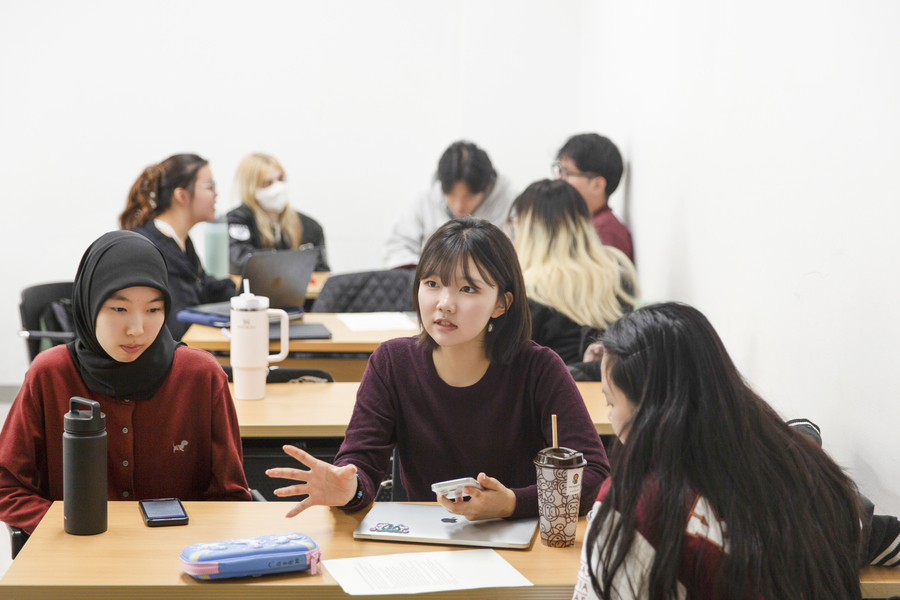
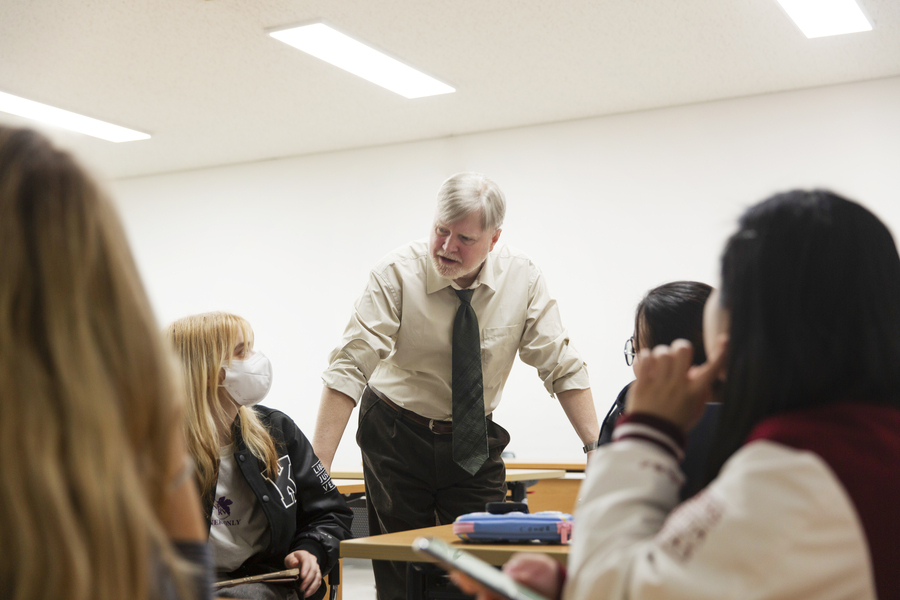
The moment you step into the classroom, you are greeted by the lively buzz of discussion. There is no trace of the silence typically associated with students passively taking notes while listening to a lecture. Instead, students roll oversized dice and freely exchange ideas on whichever topic corresponds to the number they land on. One of the University College’s most popular English-language courses, Exploring Conspiracies, Controversies, & Mysteries is far more than a class about sensational gossip. It is a dynamic laboratory where students learn to question what is commonly accepted as fact and to critically examine the hidden contexts behind it.
Reconstructing History with Dice and Timelines
Professor Blackwood's teaching style is as engaging as a game, yet carefully structured. Each week begins with a quiz on a new historical case, followed by group discussions in which students roll a Dungeons & Dragons (D&D) twenty-sided die to determine one of twenty academic questions related to conspiracy theories. Professor Blackwood likens this process to "eating veggies." If discussing sensational mysteries is like enjoying sweet chocolate, then taking an academic approach to conspiracy theories is like eating vegetables. It may not be as immediately appealing, but it is essential.
One of the course's highlights is the Event Timeline project. Working in teams, students compile the key moments of historical events such as the assassination of President John F. Kennedy or the sinking of the Titanic. Their completed timelines are then transformed into documents resembling redacted CIA files by removing dates and key details before being passed to another group. Using only these fragmented clues, students work together to reconstruct the sequence of events like solving a puzzle.
Students are also permitted to use AI for assignments, provided they follow the course guidelines. Professor Blackwood emphasizes, however, that "AI is an excellent brainstorming tool, but it should never replace your own voice or creative spark." The semester concludes with midterm and final papers that present the results of each student's investigation.
Connections That Cross Borders: "I Came to Korea to Take This Class"
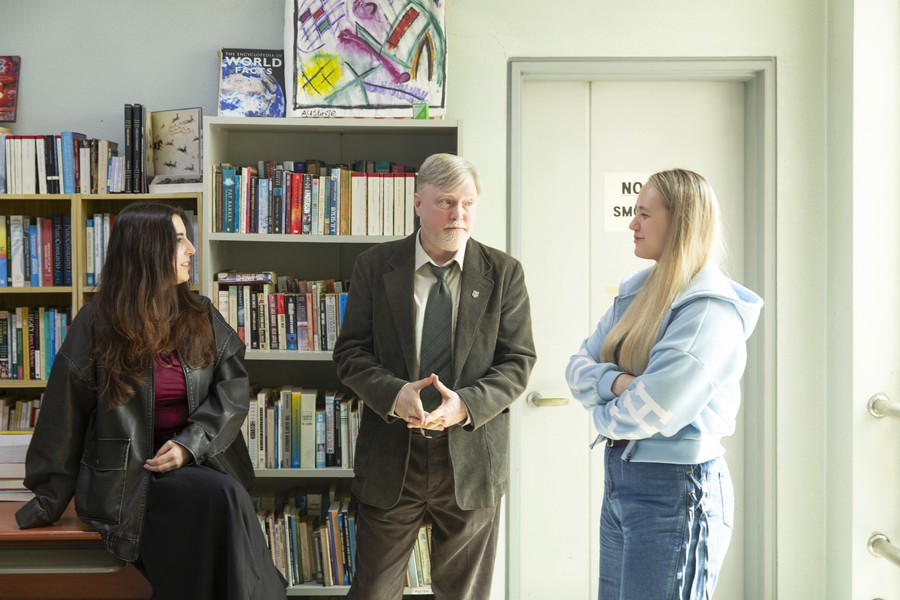
During our visit to Professor Blackwood's office, two students currently enrolled in his class, Maria and Sienna, were chatting comfortably with him. Both had taken Exploring Conspiracies, Controversies, & Mysteries the previous semester and were so impressed by his teaching style that they enrolled in another of his courses this semester. Even during the interview, the three conversed naturally, reflecting the close rapport they had built.
Maria Professor Blackwood's classes are incredibly engaging. This is my final semester, and I wanted one more opportunity to take a class with my favorite professor.
Sienna To be honest, this course was one of the main reasons I decided to come to Korea as an exchange student. Most major courses focus on delivering established facts, but here we are encouraged to express our own opinions and have discussions with students from many different academic backgrounds. That is what I enjoy most.
For Professor Blackwood, the most rewarding aspect of teaching is seeing students connect across nationalities and disciplines, listen carefully to one another's reasoning, and ultimately become friends through the classroom experience.
The Making of an Unconventional Course
Professor Blackwood has been a longstanding member of the Korea University faculty since joining the university in 1998. As the number of international students increased rapidly after 2022, the university expanded its English-language elective offerings. This created an opportunity for his long-standing interests in mythology, religion, and mystery to evolve into a formal course.
His fascination with conspiracy theories began in an unexpected way. In the late 1990s, while exploring the library stacks through an academic building that was still under construction, he came across a book titled Korean Folk Tales. His curiosity was further fueled by a colleague who firmly believed in conspiracy theories, as well as by his growing interest in the ways modern media shapes and reframes information. As he puts it, "The longer you live, the more you realize how many mysterious and unknowable things there are in the world." Those questions accumulated over a lifetime eventually gave rise to the distinctive course he teaches today.
Curriculum
Exploring Conspiracies, Controversies, & Mysteries
Week 1
Ethics and Responsibility
Week 2
Conspiracy Theories Throughout History
Week 3
Government Cover-ups and Scandals
Week 4
Social Media and Misinformation
Week 5
Paranormal Phenomena and Mysteries
Week 6
Representations of Conspiracies, Controversies, and Mysteries
" Keep your brain turned on."
At the heart of Professor Blackwood's course is not simply the transmission of knowledge, but the cultivation of critical thinking. In an age saturated with information, the course seeks to help students understand the psychological factors that draw people toward conspiracy theories while developing the ability to evaluate the credibility of information and news for themselves. "No matter what ideas are presented to you, you should always keep your brain turned on so that you are not indoctrinated. It is important to remain open-minded while maintaining a healthy sense of skepticism, carefully analyzing and evaluating every claim."
The students agree that the course has fundamentally changed the way they view the world.
McKenzie Unlike my biomedical science courses, this class gives me many opportunities to interact with other students. Now, whenever I encounter new information, my first instinct is to ask myself, "Why is it being presented this way?"
Isaiah I used to think conspiracy theories were nothing more than online gossip, but exploring them from an academic perspective was a refreshing experience. It made me realize that learning can truly be enjoyable.
Emma I learned that many conspiracy theories originated in the United States, and it was fascinating to see how students from different countries interpreted these narratives. More importantly, the course helped me develop a more nuanced understanding of why people become deeply attached to certain beliefs.
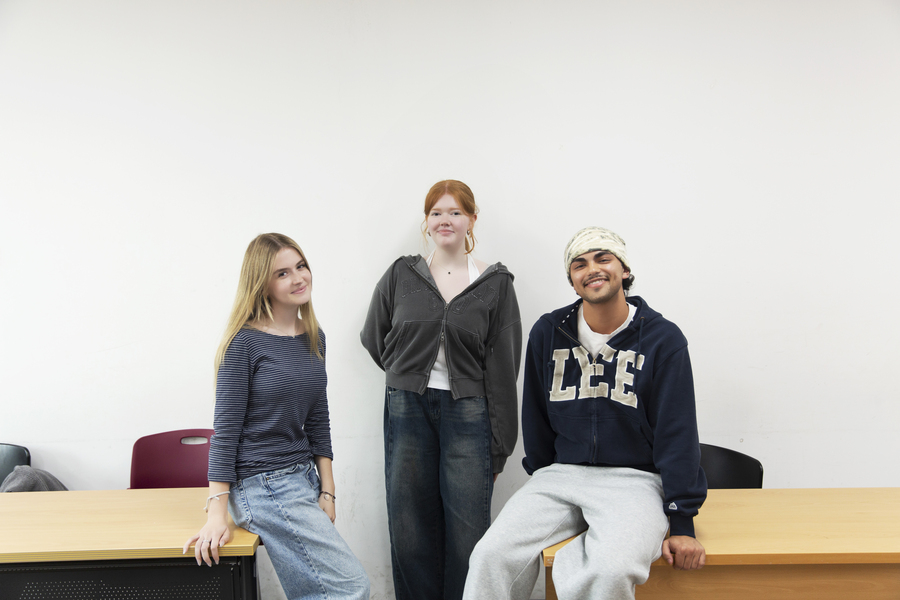
Inside Professor Blackwood's classroom, where the dice are rolled every week, students continue to sharpen their critical thinking skills. In an environment filled with lively debate and intellectual curiosity, they reflect on one another's perspectives and learn to approach the truth from multiple angles.