- writing date 2023.12.18
- author KU TODAY
- hits 34
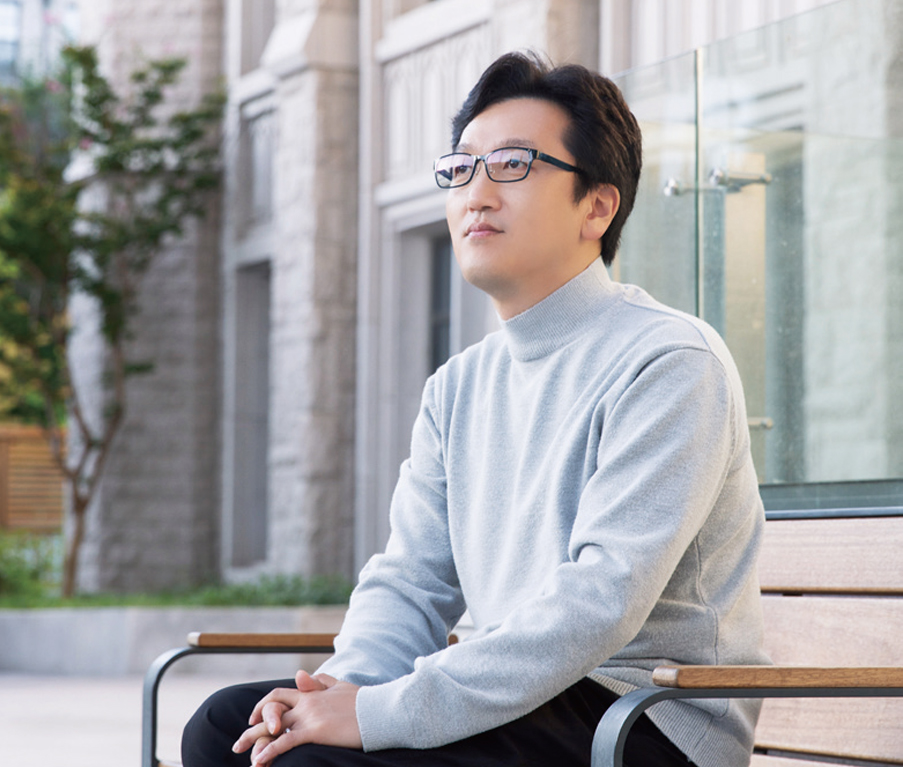
Min Han
Our everyday language contains numerous terms that provide insights into our mental states and psychological well-being. Those in the field of cultural psychology have explored these concepts in order to establish a theoretical framework for understanding the Korean mind. Let's delve into the cultural concepts of uhgul (억울; 抑鬱), hwa-byung (화병; 火病), han (한; 恨), heung (흥; 興) and shinmyeong (신명) to gain a deeper understanding of how we experience our own emotions.
Min Han
Min Han has been conducting research that connects culture, social phenomena, and psychology. He is the author of such books as 선을 넘는 한국인, 선을 긋는 일본인 (Koreans Who Cross the Line, Japanese Who Draw the Line) (2022); 슈퍼맨은 왜 미국으로 갔을까 (Why Did Superman Go to America?) (2018); and 우리가 지금 휘게를 몰라서 불행한가 (Are We Unhappy Because We Don’t Know Hygge?) (2019) .
Han: The Emotion that Persists in the Hearts of Modern Koreans
Koreans frequently use the word “uhgul-hada” (억울하다). Transcribed in Chinese characters as 抑鬱, it signifies the state of feeling oppressed and dejected, and is commonly translated as “depression.” However, for Koreans, uhgul encompasses an element of indignation that goes beyond mere depression. In other words, it is used to convey a feeling of extreme frustration and resentment when one experiences an unjust or unfair situation.
Uhgul has been cited as a contributing factor in hwa-byung. Hwa-byung, included in the fourth edition of The Diagnostic and Statistical Manual of Mental Disorders (DSM-4), is a culture-bound syndrome unique to Korean culture. In psychiatry, its cause is attributed to the suppression of emotions such as anger. Hwa-byung arises from the inability to vent anger stemming from uhgul.
According to cultural psychology research, uhgul is also connected to han, which lies on the same spectrum of emotion or affect as hwa-byung. While the concept of han may not be readily familiar to modern Koreans, an examination of their experiences reveals that they still encounter the related emotion.
'It’s My Fault, It’s My Fault'
Cultural psychology places the causes of han into three categories: unjust discrimination, relative deprivation, and unfortunate outcomes resulting from one's own mistakes. The first and second causes of han, which can be summarized as 'uncontrollable circumstances,' are directly linked to the initial emotions of han and uhgul. In the past, when society was rigidly hierarchical, incidents that triggered uhgul and indignation were often difficult to resolve. Living with such intense emotions for prolonged periods had detrimental effects on both body and mind. This unresolved uhgul eventually developed into hwa-byung.
Since ordinary people had to find a way to suppress their uhgul and anger, and still do, they seek the cause within themselves. This process is known as ‘internal attribution.’ Although the source of uhgul is external, it is easier to attribute blame to oneself rather than address surrounding underlying unfairness. The belief that one's lack of education, strength, or financial resources has led to misfortune is therefore prevalent.
As a consequence of this internal attribution, the emotion of uhgul transforms into seoreoum, which is the feeling of helplessness and sadness that arises from situations beyond one’s control. It is a defensive emotion that emerges when there is nothing more one can do.
Han as Energy for Change
Human beings possess a need for control, which significantly impacts their self-esteem and mental health. Situations that give rise to han signify a loss of control, leading to a decline in self-worth and subsequent negative consequences.
In such circumstances, simply identifying possible sources of control can provide a sense of stability. This is the first function of han. By acknowledging that the ultimate cause of negative events lies within oneself, one can reclaim a sense of control that was previously lost. During the pre-modern era when most commoners were forced to accept the injustices they faced, this psychological process likely served as a crucial mechanism for coping with negative emotions. After all, in the face of overwhelming circumstances beyond one's control, finding an explanation like "it's my fault" offered a sense of closure.
The effects of internal attribution go beyond this. Han triggers a motivational force beyond self-pity and self-compassion, the instinct to maximize one’s control. Those who believe their misfortunes stem from a lack of education strive to learn, those who attribute their hardships to financial constraints work to earn more, and those who perceive their lack of strength seek to empower themselves, attempting to overcome the circumstances that caused uhgul and seoreoum.
한While han alleviates the anger stemming from the injustices one faces, it simultaneously transforms that energy into internal motivation, underpinning the desire to overcome those unfair circumstances. Therefore, for Koreans, han is not something that clings to them for their lifetime, preventing them from moving forward, but rather something that needs to exist and that has to be released. The resilience of Korean culture, which has enabled a once poverty-stricken nation to become a leading economic power, has its roots in this ability to rise again and again, even in the face of adversity.
Shinmyeong: The Ideal Korean Emotion
When han is overcome, a very positive and energetic emotion emerges: shinmyeong. The dimensions of "han” and “shinmyeong" have always been intermingled in Korean art. The dance called salpuri, which is considered to be the most han-filled dance, gradually transforms into a dynamic and powerful performance, ending with shinmyeong-filled gestures. That's why the dance is named salpuri, puri meaning resolution.
If han is a negative emotion that one feels when one loses control and one's self-worth is damaged, shinmyeong is a positive emotion that one feels when one's sense of control and self-worth are fully restored and operative in one’s life, which explains why the emotion of shinmyeong is so strong. It is accompanied by intense reactions such as the heart beating fast and violently, and the individual jumping up and down and shouting almost in a trance-like state, in order to express intense joy. It is a state in which one feels that one becomes a supernatural being, as if a god has entered one’s body.
However, there are almost no cases in which han that has been ascendant for a long time suddenly turns into shinmyeong. In addition, external conditions alone can never overcome han. In order to do so and experience shinmyeong, numerous processes on the part of the individual are required, including efforts to identify what one can do to fight unfair and unjust circumstances and to establish one’s self-worth.
The process of restoring damaged self-esteem is not very enjoyable at first. It is frustrating, sad, and piteous. However, if one continues to move forward, at some point one feels that the situation is improving. Although it might not look like much has changed, viewed from the outside, you will nevertheless feel that an important change is happening inside you.

Heung: Internal Reanimation
At this point, the tasks that were once boring are now enjoyable and energizing, because they are now a way to restore your sense of self-worth. Others begin to recognize your efforts and your worth. The individual now hopes that they will be able to express their will to the fullest one day. These are the feelings of heung.
Heung literally means that something is "happening" within your inner self. It is the excitement and joy of regaining control over your life, hope for the future, the gradual restoration and revelation of your value, and the surging desire to reveal and express yourself even more. We need heung because only when we have it can we feel the meaning and pleasure of living.
Heung is a midpoint on the emotional journey from han to shinmyeong. While heung is the excitement and joy that has just begun to arise within ourselves, shin, shinbaram and shinmyeong are much stronger and mature emotions. The expression “흥이라는 것이 폭발한다" (“This thing heung is exploding”) often used in TV shows nowadays has the same meaning as “신난다” (being excited) or “신명난다" (feeling shinmyeong).
The Path to Shinmyeong
Shinmyeong is the emotion that shines brightly when one’s lost or weakened value is fully restored and expressed. It is a feeling of bright and positive energy that flows endlessly when oneself and the world become one (an immersion, a sense of unity, or a trance). It is difficult to experience this emotion often in life, but Koreans pursue shinmyeong in everything. Experts in various fields point out that Koreans are prone to imposing very “high standards" on themselves. There is definitely a pattern of behavior among Koreans, in which, once they are “hooked” on something, they cannot just stop until they have really mastered it.
As a result, shinmyeong can also lead to unhappiness, as such high standards are hard to meet when someone performs to a merely acceptable standard. The reason why the happiness index of Korea is unusually low might lie here. The fact that shinmyeong is considered ideal and sought after means that there is a great possibility that one’s current reality, without sufficient shinmyeong, will be perceived as miserable and painful.
Shinmyeong has certainly provided motivation for Korean society to overcome difficult times, but it may have made us unable to see the meaning of life in everyday moments, thinking that they are too trivial. It is always good to overcome han and pursue shinmyeong. However, it is also necessary to cherish the journey to shinmyeong itself. May the heung be with you.
 흥.jpg
흥.jpg