

KU Extends the Lifespan and Increases the Efficiency of Lithium Metal Batteries
- categorization Research
- writing date 2025.05.27
- author Communication Team
- hits 78
KU Extends the Lifespan and Increases the Efficiency of Lithium Metal Batteries
Joint research with Seoul National University brings us one step closer to the commercialization of next-generation batteries by developing an additive-based interfacial stabilization technology.
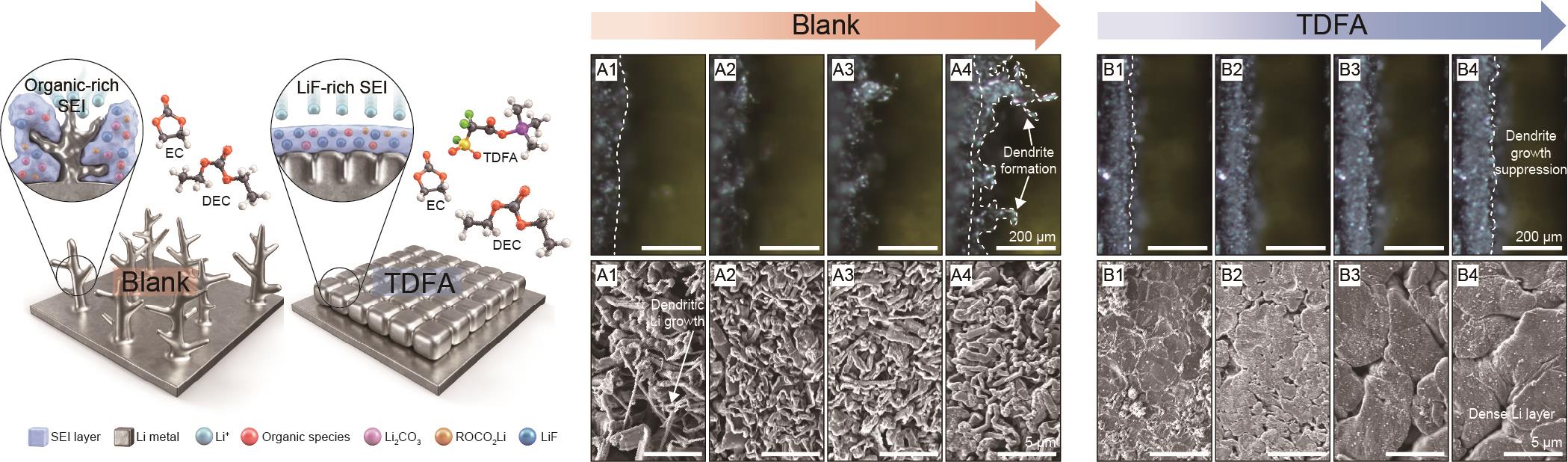
△ A schematic illustrating the effect of the trimethylsilyl 2,2-difluoro-2-(fluorosulfonyl)acetate (TDFA) additive on lithium metal anode deposition and its excellent dendrite suppressing effect.
A research group led by Professor Yu Seung-ho from the Department of Chemical and Biological Engineering at KU (President Kim Dong-Won) conducted a joint study with Professor Sung Yung-eun’s group from Seoul National University and elucidated the interfacial stabilization mechanism of the electrolyte additive TDFA to address the issue of limited lifespan in lithium metal batteries.
*TDFA(trimethylsilyl 2,2-difluoro-2-(fluorosulfonyl)acetate): A special additive that serves as a surface stabilizer.
The results of this study were published online on April 19 in the international journal Energy Storage Materials (Impact Factor: 18.9).
*Article title: Bifunctional trimethylsilyl-modified fluorinated ester additive for LiF-rich solid electrolyte interphase in lithium metal batteries
*DOI: 10.1016/j.ensm.2025.104271
*URL: https://doi.org/10.1016/j.ensm.2025.104271
Lithium metal batteries are drawing much attention as a next-generation energy storage technology because their theoretical capacity is ten times more than that of conventional lithium-ion batteries, potentially overcoming current energy density limitations. However, repeated charging and discharging often results in uneven lithium deposition, leading to surface instability and ultimately reducing battery capacity and shortening the battery’s overall lifespan.
To solve these problems, the joint research team analyzed the effects of the additive TDFA, which contains both fluorine and silicon, on the solid electrolyte interphase (SEI) formation and the solvation structure. The results showed that TDFA is preferentially reduced in the electrolyte and that the formation of a lithium fluoride (LiF)-rich SEI layer occurs spontaneously. In addition, the researchers conducted simulations and microscopic analyses, further revealing that ion mobility was improved and that lithium was deposited more uniformly in environments with TDFA.
*Solid electrolyte interphase (SEI): A thin layer that forms on the electrode surface. An SEI regulates the transport of lithium ions and protects the anode.
*Solvation structure: An arrangement of solvent molecules surrounding a lithium ion in an electrolyte.
*LiF: A key material that stably protects the surface of lithium metal.
The joint research team demonstrated that TDFA suppresses dendrite formation and forms a stable interface, thereby playing a crucial role in improving battery lifespan and charging efficiency. This study is significant because it precisely revealed how additives function at the lithium metal interface and thus presented an important direction for establishing interfacial design strategies in order to commercialize next-generation lithium metal batteries.
*Dendrite: Lithium crystals deposited on an electrode surface.
KU Professor Yu Seung-ho said, “For the commercialization of lithium metal batteries, ensuring the interfacial stability and controlling lithium deposition are essential. By elucidating the mechanism of SEI control using additives through this study, we will be able to contribute to the realization of next-generation high-energy density batteries in the future.”
This study was supported by the Ministry of Science and ICT and the National Research Foundation of Korea.
[Figure 1]

△ [Figure 1]: (From left) Professor Yu Seung-ho (co-corresponding author) from the Department of Chemical and Biological Engineering at KU, Professor Sung Yung-eun (co-corresponding author) from the Department of Chemical and Biological Engineering at Seoul National University, Park Eun-bin (student in integrated master-doctoral degree programs at SNU, co-first author), Lee Young-hoon (post-doc researcher at KU, co-first author).