Both an Artificial Synapse and a Neuron: A Human Brain–Emulating Semiconductor Developed to Accelerate the Advancement of Physical AI
- categorization Research
- writing date 2026.09.29
- author Communication Team
- hits 58
Both an Artificial Synapse and a Neuron: A Human Brain–Emulating Semiconductor Developed to Accelerate the Advancement of Physical AI
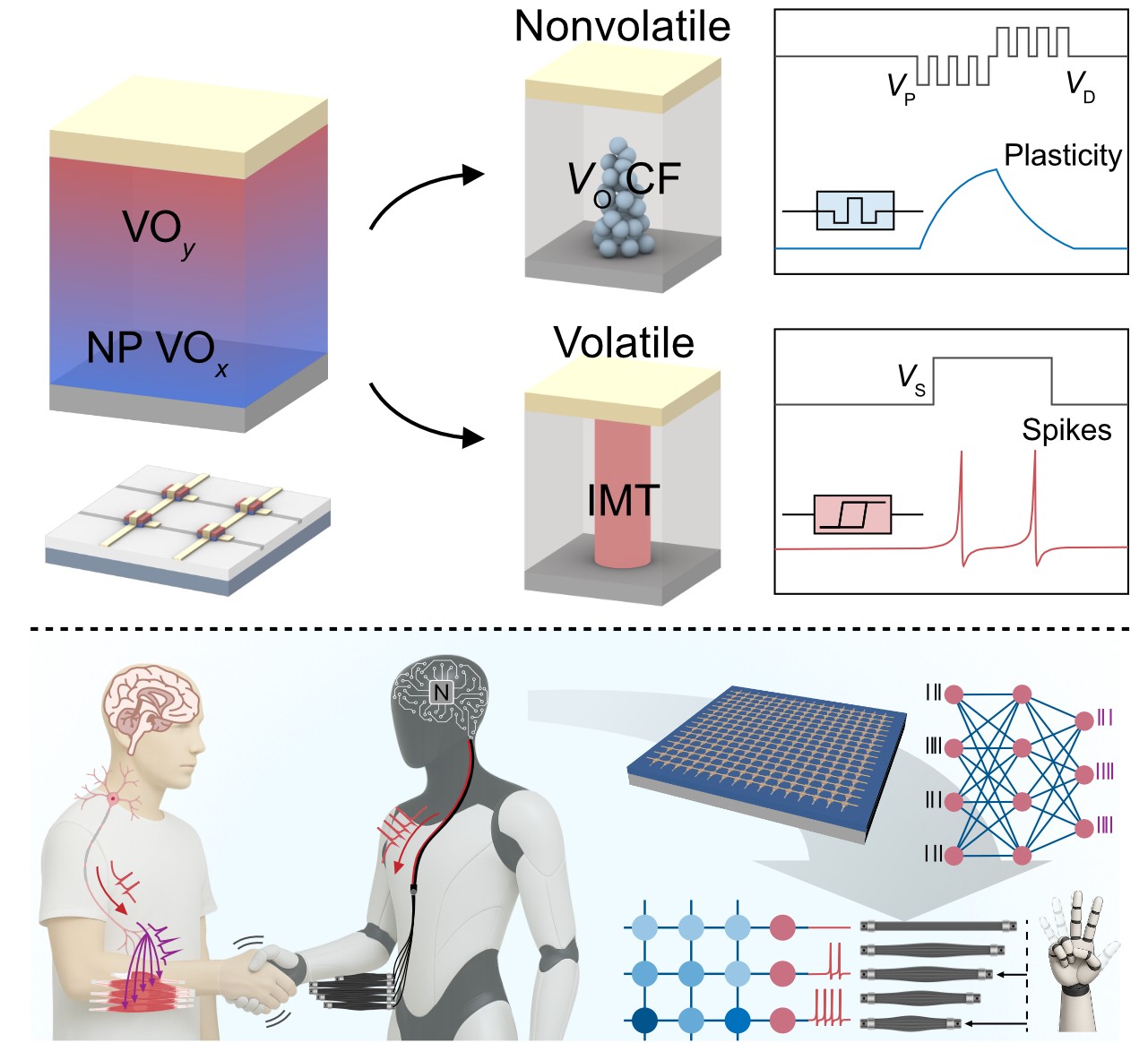
△ Schematic illustration of a vanadium oxide memristor and robotic-hand motion control. The researchers realized both volatile artificial neuronal and nonvolatile artificial synaptic functions by engineering the microstructure of the vanadium oxide film and demonstrated an artificial neural network and a motor-control system featuring these functions.
Recent research has found that a single semiconductor device can selectively perform both memory and signal-generation functions. A research team led by Professor Wang Gunuk of the KU-KIST Graduate School of Converging Science and Technology and the Department of Integrative Energy Engineering at Korea University (President Kim Dong-One), jointly with a research team led by Dr. Yang Sungwook of the Korea Institute of Science and Technology (KIST), has developed a technology for reconfigurable neuromorphic devices.
The human brain stores and processes information through the close interconnection of neurons, which generate signals, and synapses, which store information. This mechanism is implemented in electronic devices using neuromorphic technology. Rather than separating memory and processing units as in conventional computers, neuromorphic systems seek to closely integrate information storage and processing in a brain-inspired manner, thereby reducing data movement and energy consumption.
Artificial synapses require the ability to retain information over extended periods (known as nonvolatility), whereas artificial neurons require the ability to generate signals and subsequently return to their initial state (known as volatility). Because these functions require distinct electrical properties, neuromorphic systems have traditionally been implemented using different materials or devices for each function. This approach, however, is limited in that manufacturing processes and circuit architectures become increasingly complex when the system is scaled up.
The research team addressed this issue by engineering the internal structure of a single semiconductor device—a vanadium oxide memristor—to realize both functions. The key innovation was the formation of an asymmetric nanoporous structure with an oxygen vacancy–rich layer within the device using thermal treatment. In the device, the nanopore- and defect-rich region functions as an artificial synapse, while the region with a dense structure and fewer voids acts as an artificial neuron. As a result, a single device can be selectively configured for use as a synapse or neuron, depending on the desired functionality.
*Vanadium oxide memristor: A next-generation intelligent semiconductor device designed to store and process data using voltage-responsive vanadium oxide.
After stacking the developed devices into a crossbar array and evaluating their performance, the research team confirmed paired synapse–neuron operation, in which the programmed synaptic conductance modulated the neuronal signal amplitude and firing frequency.
Using these devices, the research team also constructed and validated a low-power artificial neural network inspired by the operation of the human brain, referred to as a spiking neural network (SNN). The synaptic functionality of the devices learned and retained the characteristic patterns of the rock–paper–scissors game, while the neuronal functionality recognized input images and generated the corresponding output commands. As a result, the system classified images of rock–paper–scissors hand gestures with an accuracy of up to 98.38%. The system was directly integrated with a robotic motor control system, enabling the robot to perform rock, paper, or scissors gestures according to the recognized images.
This study is significant in that, rather than combining separate devices with different functions, the research team engineered the internal structure of a single device so that it could selectively perform distinct information-processing functions. By integrating multiple devices into large-scale arrays and combining them with peripheral circuits, this technology is expected to be extended to edge AI, physical AI, intelligent sensors, and low-power neuromorphic semiconductor systems.
*Edge AI: Artificial intelligence that processes and makes decisions directly on a local device, without processing information through a cloud server.
The findings of this study were published online on August 17, 2026, in Advanced Materials, an international academic journal in the field of materials science.
*Article title: Structure-Engineered Nanoporous Vanadium Oxide Memristors for Reconfigurable Synapse–Neuron Integration and Synergistic Robotic Motion
*DOI: 10.1002/adma.74670
*URL: https://doi.org/10.1002/adma.74670
This study was conducted with support from Korea University, KIST, and the National Research Foundation of Korea (NRF).
[Photograph of the research team]