Secrets Hidden in a 118-Million-Year-Old Dinosaur Tooth — Atomic-Scale Analysis Allows the Diet and Habitat of Dinosaurs to Be Traced
- categorization Research
- writing date 2026.08.07
- author Communication Team
- hits 42
Secrets Hidden in a 118-Million-Year-Old Dinosaur Tooth — Atomic-Scale Analysis Allows the Diet and Habitat of Dinosaurs to Be Traced
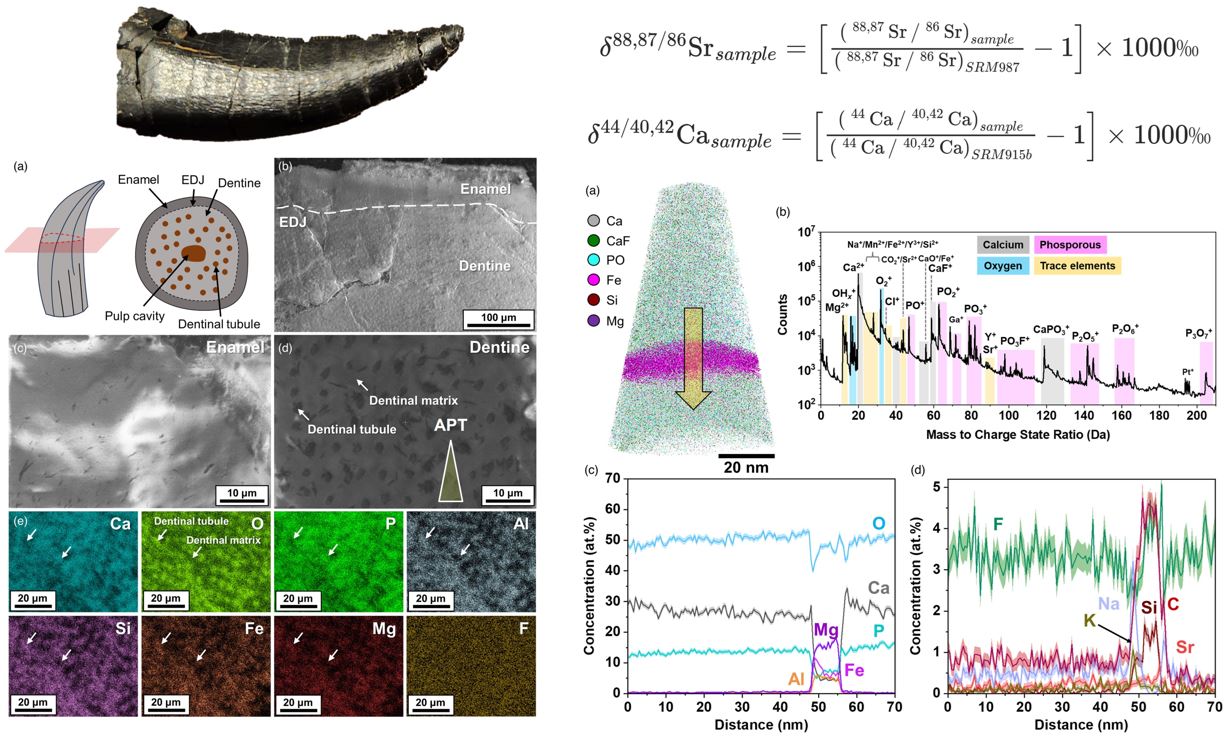
△ Results of the multiscale analysis of a fossil dinosaur tooth. Using advanced atom probe tomography (APT), the research team successfully distinguished, at an atomic scale, the chemical information retained while the dinosaur was alive from the changes that occurred during fossilization.
What did dinosaurs eat, and where did they live? A research team led by Professor Kim Se-ho of the Department of Materials Science and Engineering at KU (President Kim Dong-One), in collaboration with Dr. Lee Sung-jin of the Research Institute of Basic Sciences at Seoul National University and Dr. Jang Kyu-seon of the Max Planck Institute for Sustainable Materials in Germany, has conducted an atomic-scale analysis of a tooth of a carcharodontosaurid dinosaur from about 118 million years ago, potentially laying the foundation for answering these elusive questions.
The teeth of a dinosaur can retain information about the food it ate, the water it drank, and the region where it lived. Of the various isotopes preserved in fossils, carbon (C) and nitrogen (N) can be used to estimate a dinosaur’s diet and its position in the food chain. Analyzing strontium (Sr), which reflects the characteristics of local rocks and water, also makes it possible to trace where a dinosaur lived and its migration routes. In addition, calcium (Ca) and oxygen (O) isotopes can provide information on dietary habits and the ecological and climatic environment of the time.
However, groundwater and components of the surrounding soil can infiltrate the fossil as it lies buried for tens of millions of years, so it is difficult to determine whether a detected component was present when the dinosaur was alive. To address this problem, the team used APT, an advanced analytical instrument established at KU, to analyze the tooth fossil of a Cretaceous carnivorous dinosaur (family: Carcharodontosauridae) from about 118 million years ago, which was found in the Hasandong Formation on Juji Island, Hadong-gun, Gyeongsangnam-do.
*Atom probe tomography (APT): an advanced analytical technique that removes atoms one by one from a specimen, analyzes them, and produces a three-dimensional map at the atomic scale showing which element was located where.
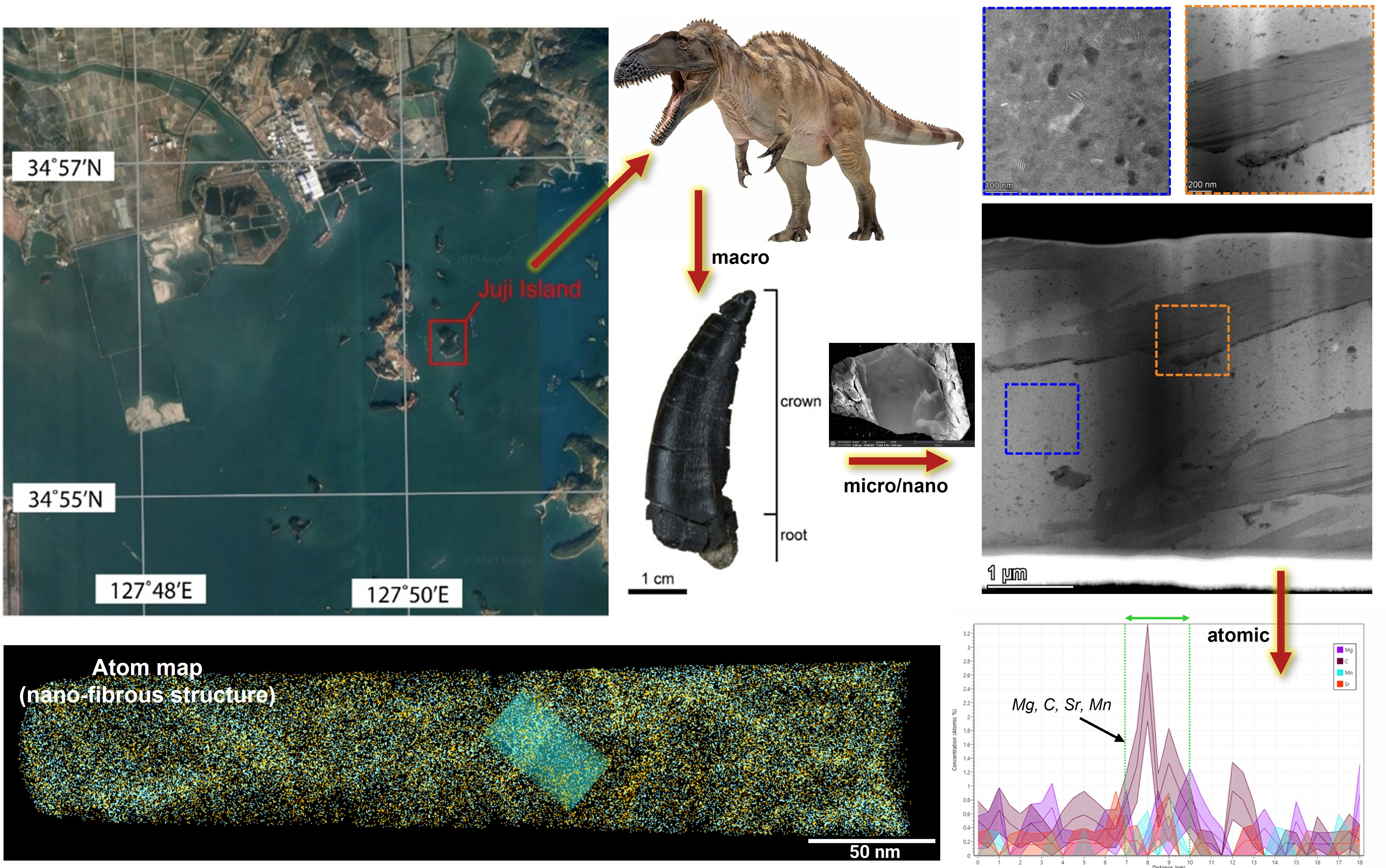
△ APT results for the tooth of a Cretaceous carcharodontosaurid dinosaur from about 118 million years ago excavated on Juji Island, Hadong-gun, Gyeongsangnam-do.
The results showed that the original crystalline structure of the enamel, the protective outer layer of the tooth, was relatively well preserved, whereas the dentine, the tissue beneath the enamel, was strongly affected by the groundwater and surrounding minerals during fossilization. Furthermore, using APT, the team succeeded in distinguishing, at the atomic scale, between regions within the enamel that preserved the chemical information from when the dinosaur was alive and regions that were altered during fossilization.
Previously, these regions were often analyzed together without distinction, which could lead to differing interpretations of a dinosaur’s diet, living environment, and migration routes. This study is significant in that it overcomes this limitation and presents a new approach that allows for the atomic-scale selective analysis of only those regions that preserve information from the time when the animal was alive.
Combining advanced microscopy with high-precision isotope analysis is expected to more accurately reconstruct a dinosaur’s diet, living area, and migration routes, as well as the environment of the time. In addition, for fossils in which uranium (U) and lead (Pb) are sufficiently preserved, this approach could be extended to studies that directly measure the age of a fossil or its geological era via isotope analysis.
Professor Kim Se-ho explained, “Our study is the first to distinguish, through atomic-scale advanced analysis, information derived from when a dinosaur was alive from those changes that occur during fossilization. We expect that our results will open a new field of research that reconstructs the life history of dinosaurs from tens of millions of years ago using a tiny fossil fragment.”
The findings of this study were published online on July 21, 2026, in Microscopy and Microanalysis (IF = 3.9), a leading international journal in the field of microscopy.
*Article title: Near-Atomic-Scale Characterization of Diagenetic Signatures in a Fossil Dinosaur Tooth by Atom Probe Tomography
*DOI: 10.1093/mam/ozag060
*URL: https://doi.org/10.1093/mam/ozag060
This research was supported by the National Research Foundation of Korea (NRF) national R&D program (Ministry of Science and ICT, RS-2024-00450561), the Korea Basic Science Institute (KBSI), and a Ministry of Education support program (RS-2025-02317079).
[Research team photo]