Design of a Porous Carbon Layer for High-Performance, Long-Life Aqueous Tin Batteries
- categorization Research
- writing date 2026.10.14
- author Communication Team
- hits 15
Design of a Porous Carbon Layer for High-Performance, Long-Life Aqueous Tin Batteries
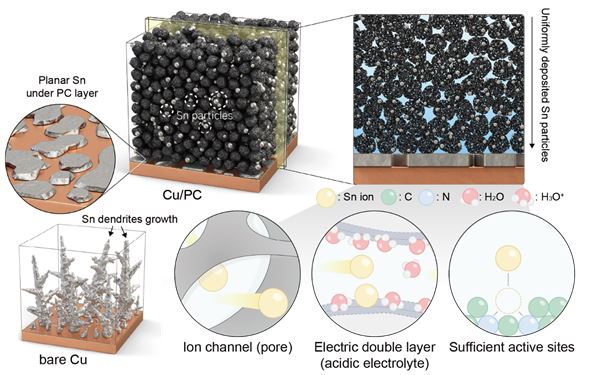
△ Schematic illustration of the multifunctional properties of the porous carbon interfacial layer and the resulting growth behavior of tin (Sn)
A technology has been developed that can substantially improve the cycle life and the charge–discharge performance of aqueous batteries, which carry a low risk of fire. A research team led by Professor Yu Seung-ho of the Department of Chemical and Biological Engineering at KU (President Kim Dong-One), working jointly with a team led by Professor Sung Yung-eun of the School of Chemical and Biological Engineering at Seoul National University, has proposed a new principle for the design of the electrode–electrolyte interface.
Lithium-ion batteries, which are currently in widespread use, offer a high energy density, but because they rely on flammable organic electrolytes, they carry a fire risk and pose thermal management issues. In contrast, aqueous batteries, which use water-based electrolytes, have a lower risk of fire and are environmentally friendly, thus they have drawn attention as next-generation batteries for large-scale energy storage systems (ESSs).
Aqueous acidic batteries (AABs) use acidic electrolytes, and tin (Sn) is regarded as a promising anode material for AABs. Sn is resistant to corrosion even in strongly acidic environments, but during high-rate charging and discharging, it accumulates unevenly on the electrode surface and grows as sharp protrusions known as dendrites, lowering the efficiency and the cycle life of these batteries.
To address this problem, the research team applied an approximately 12-μm-thick porous carbon layer to the surface of the Sn anode. Conventional anode protective layers are generally designed to physically block dendrite growth, whereas the team used a carbon layer with numerous micropores and active sites to regulate Sn ion migration and accumulation.
*Active site: A point on the surface of a material where ions or atoms attach and chemical reactions readily occur.
The porous carbon layer allowed the electrolyte to permeate smoothly into its interior, which facilitated ion migration, and it provided abundant active sites at which Sn ions could attach uniformly and begin to grow. As a result, rather than accumulating at particular spots, the Sn ions grew simultaneously as uniformly dispersed nanoparticles within the carbon layer and as a flat deposit on the substrate beneath the carbon layer. This effectively suppressed dendrite formation even under high-current conditions.
The team also identified another key reason for the uniform growth of Sn. In the acidic electrolyte, hydronium ions (H3O+), in which protons are bound to water molecules, were preferentially adsorbed on the porous carbon surface, forming a distinctive electric double layer. This environment regulated the migration and the distribution of Sn ions, inducing the formation of uniformly dispersed nanoparticles.
The Sn anode with the porous carbon layer exhibited high stability even at high currents. A full cell combining a cathode and an anode operated stably for more than 50,000 charge–discharge cycles at a current density of 30 A g−1, and a 20-cm2 pouch cell retained 83.2% of its initial capacity after 20,000 charge–discharge cycles at a current density of 10 A g−1.
*Pouch cell: A battery in which the cell components are enclosed in a thin, flexible film casing known as a pouch; it is used to evaluate the feasibility of practical applications.
Professor Yu Seung-ho said, “By observing Sn growth in real time and elucidating the role of the distinctive interfacial environment that forms in acidic electrolytes, we offer a new interfacial design principle for high-efficiency, long-life aqueous metal batteries. We expect to extend this approach to aqueous batteries based on a variety of metal anodes and thus contribute to the development of safe, large-scale ESSs.”
This research was supported by the Ministry of Science and ICT and the National Research Foundation of Korea, through the International Collaborative Development Program for Core Source Technologies (international joint research on secondary batteries) and the Basic Science Research Program. The results of this study were published online on August 27, 2026, in Journal of the American Chemical Society, an internationally renowned journal.
*Article title: Morphology-Diversified Sn Growth for Aqueous Acidic Batteries
*DOI: 10.1021/jacs.6c08047
*URL: https://doi.org/10.1021/jacs.6c08047
[Research team photo]