What Is the Actual Carbon Reduction Effect of Bioplastics? A Life-Cycle Assessment from Production to End-of-Life
- categorization Research
- writing date 2026.10.14
- author Communication Team
- hits 15
What Is the Actual Carbon Reduction Effect of Bioplastics? A Life-Cycle Assessment from Production to End-of-Life
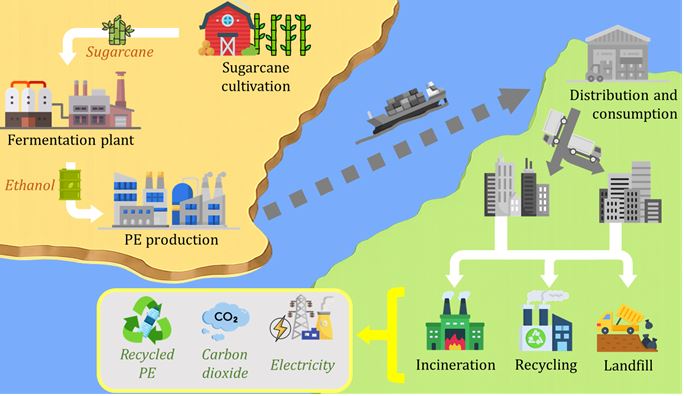
△ Schematic representation of the life cycle of sugarcane-based bio-polyethylene (bio-PE), illustrating the process from sugarcane cultivation and bioethanol production to bio-PE manufacturing, followed by distribution and use, and finally end-of-life treatment through incineration, recycling, or landfilling.
How much can bioplastics, which have garnered attention as an eco-friendly alternative to conventional plastics, contribute to reducing carbon emissions? A research team led by Professor Won Wangyun of the Department of Chemical and Biological Engineering at Korea University (President Kim Dong-One) has quantitatively evaluated the actual carbon reduction effect of bio-PE by analyzing its entire life cycle, from production to end-of-life.
Bio-PE is a type of plastic produced from feedstocks derived from biomass, such as sugarcane. Because its chemical structure and material properties are comparable to those of fossil fuel–based polyethylene (fossil-PE), it offers the advantage of being compatible with existing production and recycling infrastructure. However, bio-PE is not a biodegradable plastic that decomposes naturally in the environment and thus, like conventional plastics, it must be managed through end-of-life processes such as incineration, landfilling, or recycling after use.
*Biomass: Renewable organic resources derived from living organisms, such as plants, that can be used as feedstocks for fuels or chemical products as alternatives to fossil resources such as petroleum.
While previous studies have focused primarily on the environmental performance of the production stage, assessing the actual carbon reduction effect of bio-PE requires consideration of its entire life cycle, including end-of-life treatment. Accordingly, the research team conducted a life-cycle assessment (LCA) of three types of bio-PE—bio-high-density polyethylene (bio-HDPE), bio-low-density polyethylene (bio-LDPE), and bio-linear low-density polyethylene (bio-LLDPE)—from raw material production to end-of-life treatment.
*Life-cycle assessment (LCA): A method for quantitatively evaluating the environmental impacts of a product throughout its entire life cycle, from raw material production and manufacturing to use and end-of-life treatment.
Notably, the analysis accounted not only for the production stage but also for waste management pathways, including incineration with energy recovery, landfilling, and mechanical recycling. The team also examined how differences in the electricity mix in production and consumption regions and variation in the maritime transport distance affect carbon emissions.
The results showed that the production of 1 kg of fossil-PE generated approximately 4.59 kg of greenhouse gas (GHG) emissions, whereas the production of 1 kg of bio-PE generated only 0.39 kg, representing a reduction of approximately 91.5% (or 4.2 kg of GHG emissions per kilogram). If the entire annual domestic production of fossil-PE, amounting to 275,000 t, were replaced with bio-PE, GHG emissions could be reduced by up to approximately 1.16 Mt.
However, the analysis showed that the carbon reduction effect varied depending on the end-of-life treatment pathway. The research team calculated GHG emissions generated from the end-of-life treatment of bio-PE using data from the U.S. Environmental Protection Agency (EPA) related to polyethylene waste management. When waste treatment rates of 9.6% for incineration, 85.6% for landfilling, and 4.7% for recycling were applied, approximately 0.13 kg of additional GHG emissions were generated per kilogram of bio-PE. These findings indicate that maximizing the carbon reduction effect requires not only a transition to bio-based feedstocks during production but also improvements in waste-management practices.
Professor Won Wangyun said, “Rather than determining a product’s environmental performance solely by its use of bio-based feedstocks, we should examine its entire life cycle, from production to end-of-life treatment. The carbon reduction effect can be further enhanced when the transition to bio-based feedstocks is accompanied by improvements in waste management.”
This study was conducted with support from the Korea Agency for Infrastructure Technology Advancement (KAIA) and the Industrial Technology Innovation Program of the Ministry of Trade, Industry and Energy. The findings were published on October 1, 2026, in the international academic journal Chemical Engineering Journal (IF: 12.5, JCR top 4.0%).
*Article title: Cradle-to-grave life cycle assessment of bioplastics: Focus on end-of-life treatment
*DOI: 10.1016/j.cej.2026.179436
*URL:https://doi.org/10.1016/j.cej.2026.179436
[Photograph of the research team]