The 12th Next Intelligence Forum: The 21st Century Is the Age of Gases
- categorization Education/Events
- writing date 2026.10.14
- author Communication Team
- hits 0
Special lecture by KU Distinguished Professor Susumu Kitagawa, 2025 Nobel Laureate in Chemistry
“The 21st century is the age of gases; air is invisible gold”
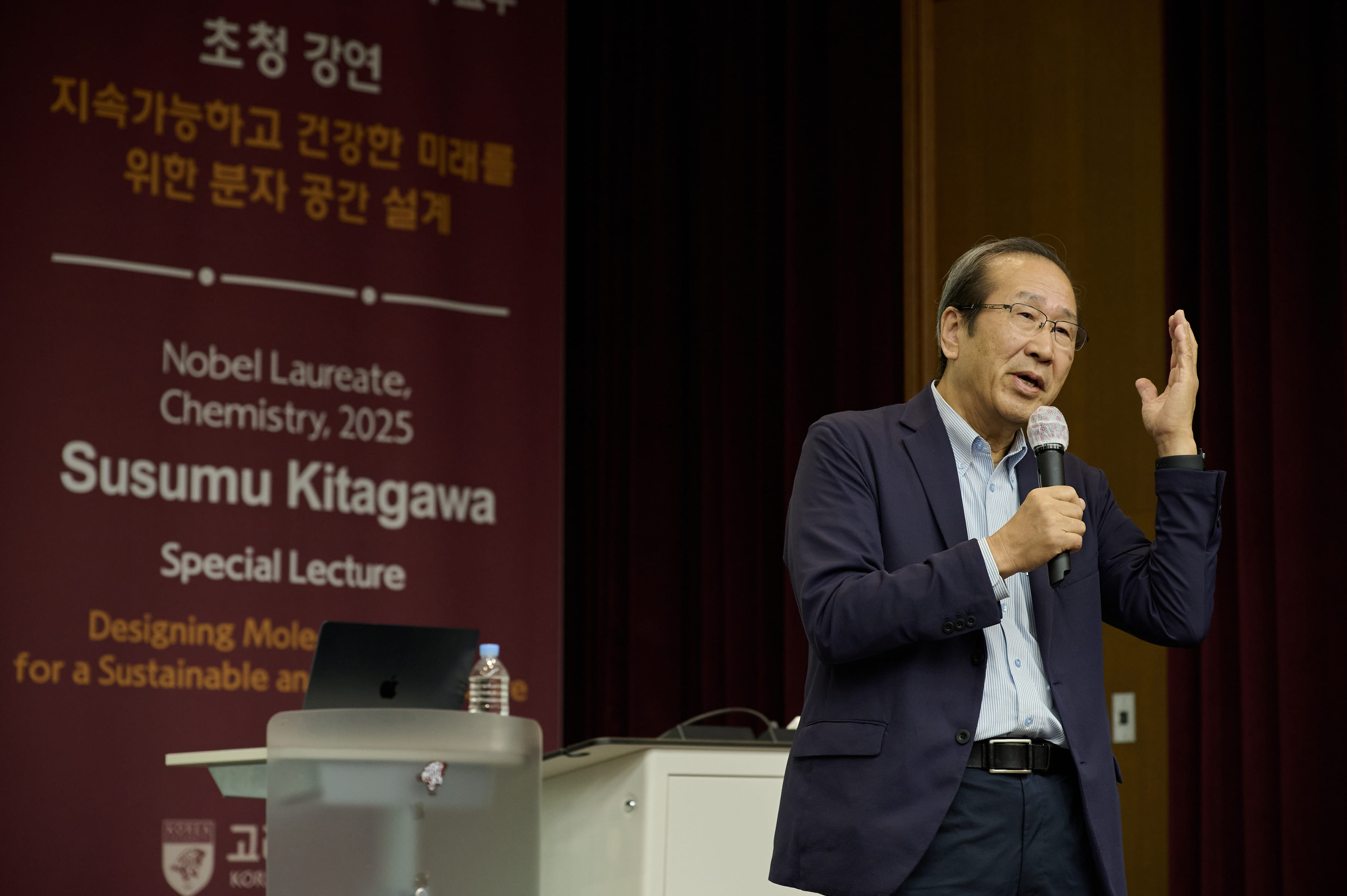
△ Professor Susumu Kitagawa delivering his lecture.
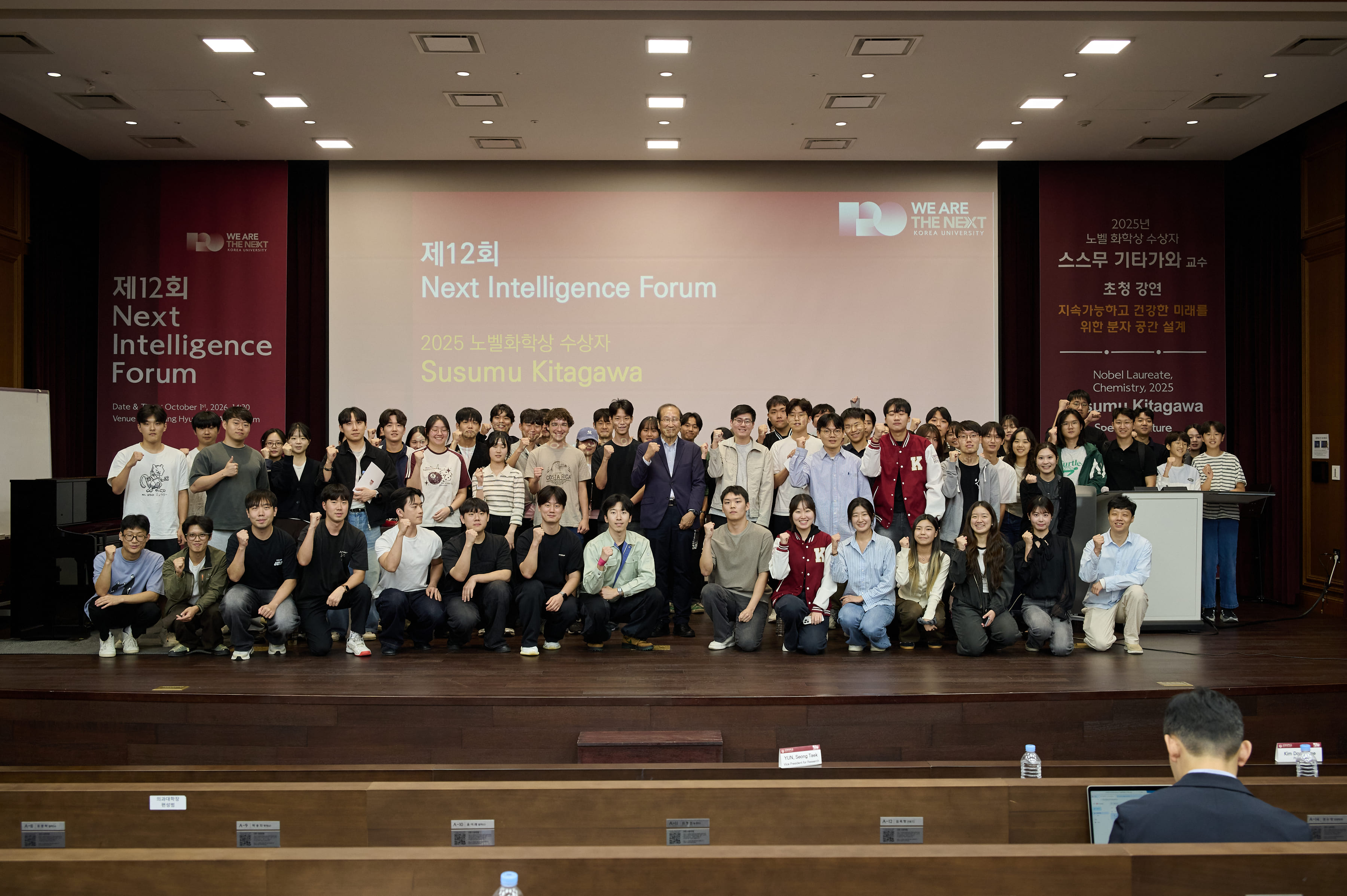
On October 1, 2026, at the 12th Next Intelligence Forum (NIF) held in Kim Yang-hyun Hall of the Main Auditorium at KU (President Kim Dong-One), Professor Susumu Kitagawa, the 2025 Nobel Laureate in Chemistry, delivered a special lecture entitled “Designing Molecular Space for a Sustainable and Healthy Future.”
Before the lecture, KU President Kim Dong-One said in his welcoming address, “Professor Susumu Kitagawa is a world-renowned scholar who pioneered research on porous coordination polymers and metal–organic frameworks (MOFs) and who was the first to propose the concept of soft porous crystals.” He added, “In particular, technologies for capturing carbon dioxide from the air and for separating and storing gases are practical solutions to the climate crisis and to energy problems, which are among humanity’s most difficult challenges.” He went on to say, “This occasion is all the more meaningful in that it marks our welcoming of Professor Kitagawa as a Distinguished Professor at the KU-KIST Graduate School of Converging Science and Technology.”
In his lecture, Professor Kitagawa predicted that, if the 19th century was regarded as the age of solids and the 20th century as the age of liquids, the 21st century will be the age of gases. Recognizing that the pursuit of a “mining civilization” has run up against the limits of resource depletion, air pollution, and global warming, he said that the direction of future industry lies in handling the carbon, hydrogen, oxygen, and nitrogen in the air with precision and combining them with renewable energy, and that, within the next 20 to 50 years, we must shift from a mining civilization to a “separation civilization” that selects and uses the gas molecules in the air. “Air is invisible gold,” he said, adding that MOFs will be the key to turning that value into reality. He explained that “molecular refineries,” which capture, concentrate, store, and convert gases, will become critical components of the infrastructure in the future.
Tracing the history of porous materials from the activated charcoal of Egypt 3,500 years ago to zeolites and the dynamite that Alfred Nobel invented using diatomaceous earth, Professor Kitagawa explained that MOFs, which consist of porous coordination polymers in which metal ions and organic molecules are linked by coordination bonds, stand at the pinnacle of this lineage. He noted that the internal surface area of a single gram of MOF exceeds that of a soccer field, allowing it to capture trace gas molecules effectively.
He then identified assembly, space, and dynamicity as the three sources of the “prepared mind” that has guided his research. As an undergraduate, he gained from Boltzmann’s equation in statistical mechanics the insight that the nanoscale and macroscopic worlds are connected; he found the value of empty space in Zhuangzi’s idea of “the usefulness of the useless,” which he encountered through a book written by the Nobel laureate in physics Hideki Yukawa; and he drew inspiration from the idea of ceaselessly changing matter encapsulated by Heraclitus’s “everything flows” (panta rhei).
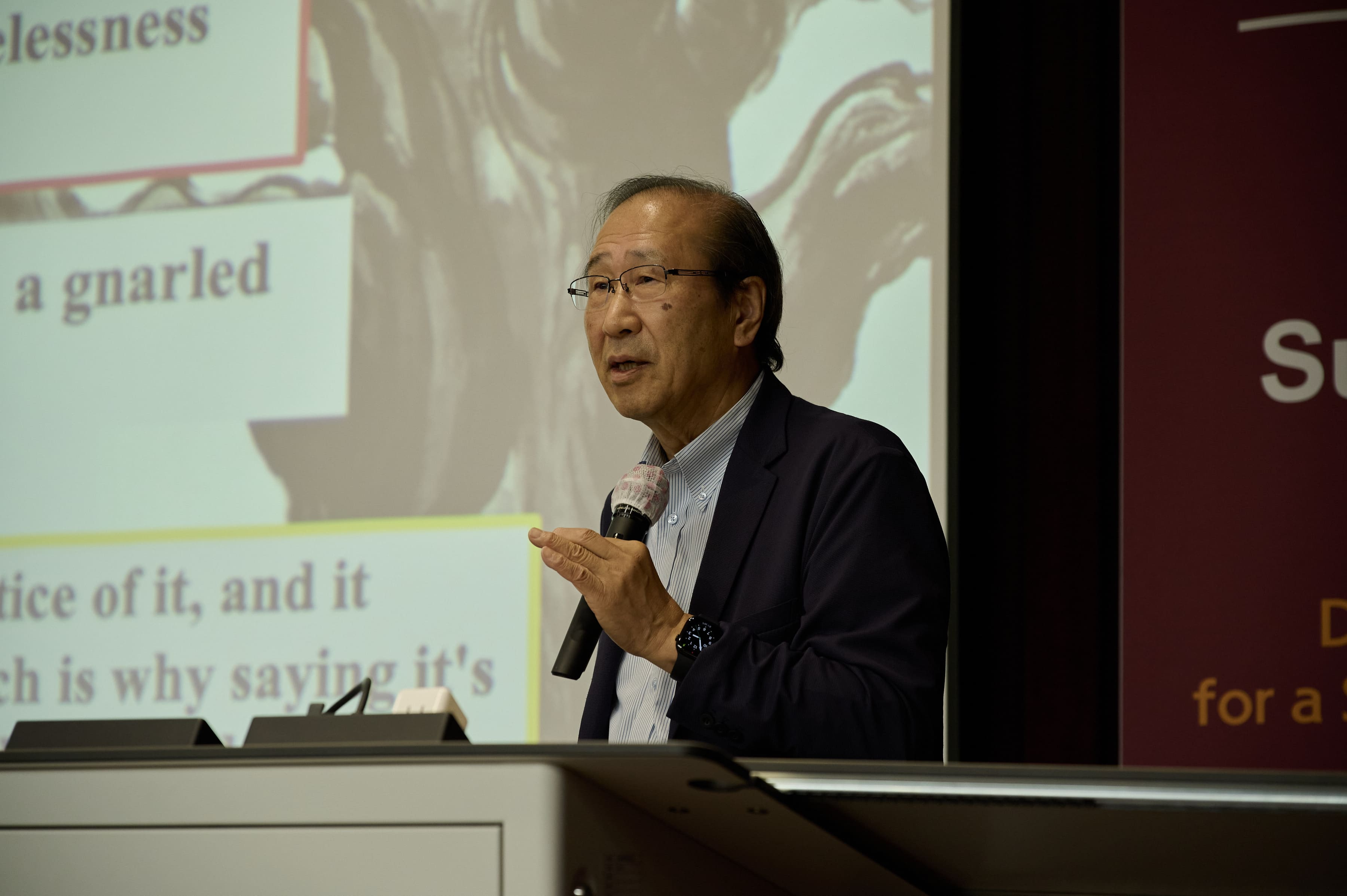
△ Professor Susumu Kitagawa delivering his lecture.
Professor Kitagawa also described the starting point of his MOF research. He recalled that he began with “seemingly useless” monovalent copper ions (Cu+), which no one had paid attention to because they have no optical or magnetic properties, and that, while he was analyzing their crystal structure, a student’s remark that “there are holes in this structure” became the turning point that redirected him toward research on porous frameworks. Despite the prevailing belief at the time that frameworks made of organic molecules were unstable, in 1997 he reported the world’s first stable MOF capable of adsorbing gases at room temperature, demonstrating the permanent porosity of MOFs.
Professor Kitagawa went on to explain how he proposed and demonstrated the concept of “soft porous crystals,” which are frameworks that deform flexibly in response to external molecules. Unlike rigid conventional porous materials, soft MOFs change their structure as if to envelop guest molecules and exhibit cooperative adsorption similar to that of hemoglobin, and this enables the selective separation of gases that are difficult to distinguish, such as carbon dioxide, methane, oxygen, and nitrogen. He said that recent work had reconfirmed that the world’s first gas-adsorbing MOF itself was a soft MOF that moves through molecular rotation. He emphasized that “local dynamic flexibility,” in which only specific regions move rather than the entire framework, is the key to practical materials that do not collapse during repeated use.
Professor Kitagawa identified the “dilute molecule economy” as the greatest challenge of the 21st century. He explained that recovering carbon dioxide, which is present in the atmosphere at about 400 ppm, and heavy water (D2O), which is present in natural water at only about 150 ppm, is like finding a needle in a haystack. In particular, heavy water, which is essential for medicine, for next-generation energy sources such as nuclear fusion, and for basic science, is chemically almost identical to ordinary water, making its separation a century-old problem that required the enormous input of energy within massive distillation columns. He explained that his team had achieved the separation of H2O and D2O, which had been impossible with zeolites or activated carbon, by exploiting nanopore dynamics in which the pore entrances fluctuate on a minute scale.
He closed the lecture by sharing with young researchers the traditional Japanese conditions for success—un (luck), don (doggedness), and kon (perseverance)—which refer to seizing good fortune through proactive preparation, maintaining the doggedness to dig to the end rather than settling for superficial answers, and holding on with perseverance. “Thinking with your own head matters more than quickly understanding new theories and materials,” he said, urging them to develop their “prepared mind” through daily practice.
The NIF is an academic forum that was established in 2025, the 120th anniversary of the founding of KU, to invite world-renowned scholars to share in-depth knowledge and to discuss the key issues that will shape the future of humanity. The NIF is sponsored by Centroid Investment Partners.