More Than One-Third of the “Forever Chemicals” in Eyeshadow Reaches the Eye
- categorization Research
- writing date 2026.10.14
- author Communication Team
- hits 16
More Than One-Third of the “Forever Chemicals” in Eyeshadow Reaches the Eye
Professor Choi Yoon-hyeong’s team at KU wins the Excellent Science and Technology Paper Award presented by the Korean Federation of Science and Technology Societies (KOFST)
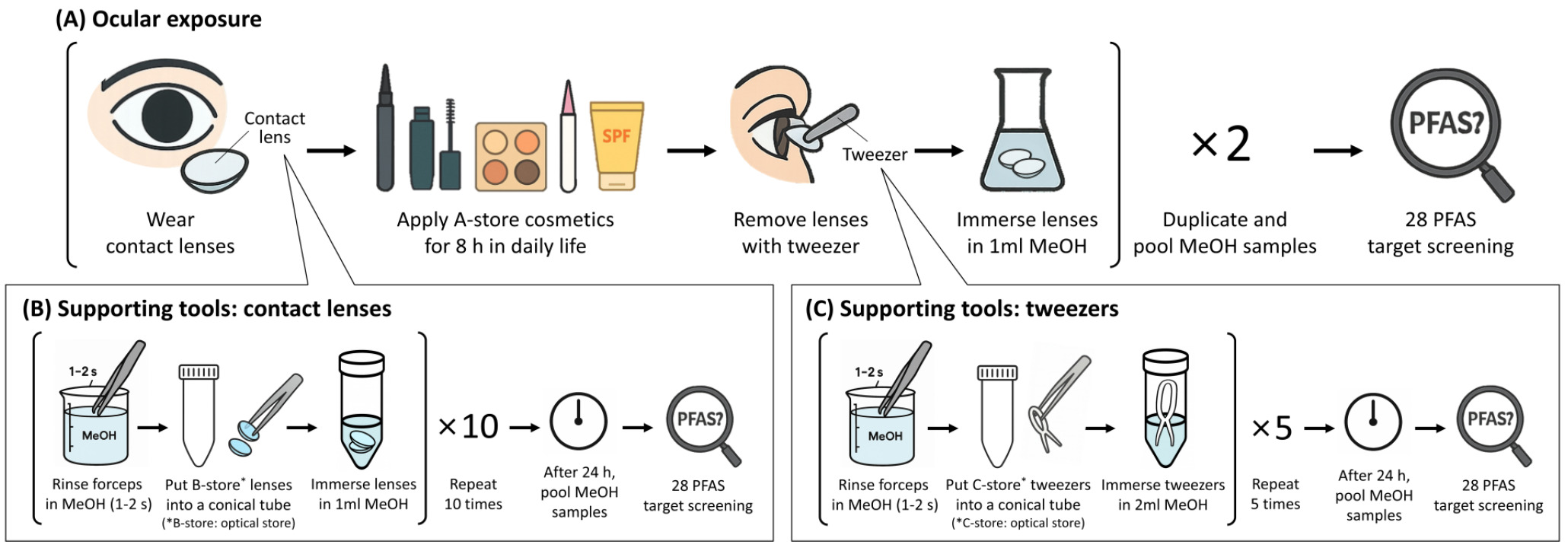
△ Assessment of ocular exposure to the PFAS contained in cosmetics using contact lenses (Phase II)
A study has found that about 38% of the per- and polyfluoroalkyl substances (PFAS) contained in eyeshadow can be transferred to the surface of the eye when eye makeup is applied. This provides scientific evidence for the route by which PFAS, known as “forever chemicals” because they do not readily decompose once they enter the body, actually reach the eye.
The research team led by Professor Choi Yoon-hyeong of the School of Health and Environmental Science at KU (President Kim Dong-One) announced that on September 30, 2026, it received the 36th Excellent Science and Technology Paper Award, presented by KOFST, for a paper that used contact lenses to determine how PFAS in eye-makeup products are transferred to the eye.
*Article title: Quantification and Ocular Exposure Assessment of Per- and Polyfluoroalkyl Substances in Mass-Market Eye-Makeup Products
*URL: https://doi.org/10.5668/JEHS.2025.51.5.273
*DOI: JEHS.2025.51.5.273
The team collected eye-makeup products sold at low-cost mass-market retailers and analyzed their composition. The researchers then reproduced the makeup application process using contact lenses, which sit against the cornea, as a proxy model for the eye.
The experimental results confirmed that about 38% of the PFAS contained in eyeshadow applied to the eyelid were transferred to the lens surface.
Because PFAS resist both water and oil, they have been used to improve the adhesion and the longevity of cosmetics. However, they do not degrade easily, and they can accumulate in the body over long periods. Therefore, they have been implicated in various health issues, including endocrine disruption and weaker immune function.
While earlier studies had focused only on confirming whether PFAS are present in cosmetics, this study is significant in that it experimentally identified the actual route by which PFAS move to the eye during everyday makeup application and the transfer ratio. The quality of this work was subsequently recognized by the KOFST Excellent Science and Technology Paper Award.
The team added that, given the nature of in vitro simulations using contact lenses, the sample size was limited, and that self-cleaning mechanisms such as tear circulation and blinking operate in the actual human eye. Therefore, they recommended that precise exposure standards that reflect the distinctive characteristics of the eye and safety management guidelines tailored to eye-makeup products be established.
Professor Choi Yoon-hyeong, who led the study, said, “We confirmed that harmful substances in the eye-makeup products people use every day can be physically transferred to the ocular surface. We will continue to provide the scientific evidence needed to protect consumer safety and to establish effective environmental health policies.”
The paper was published in the Journal of Environmental Health Sciences, with graduate student Kim Ji-won as first author and Professor Choi Yoon-hyeong of KU and Professor Jeon Jun-ho of Changwon National University as co-corresponding authors.
[Research team photo]