A KU-KIST Research Team Has Developed HiMDA Technology for High-Sensitivity Gene/Cell Doping Analysis Capable of Detecting Doping Genes 84 Hours After Doping
- categorization Research
- writing date 2025.07.28
- author Communication Team
- hits 64
A KU-KIST Research Team Has Developed HiMDA Technology for High-Sensitivity Gene/Cell Doping Analysis Capable of Detecting Doping Genes 84 Hours After Doping
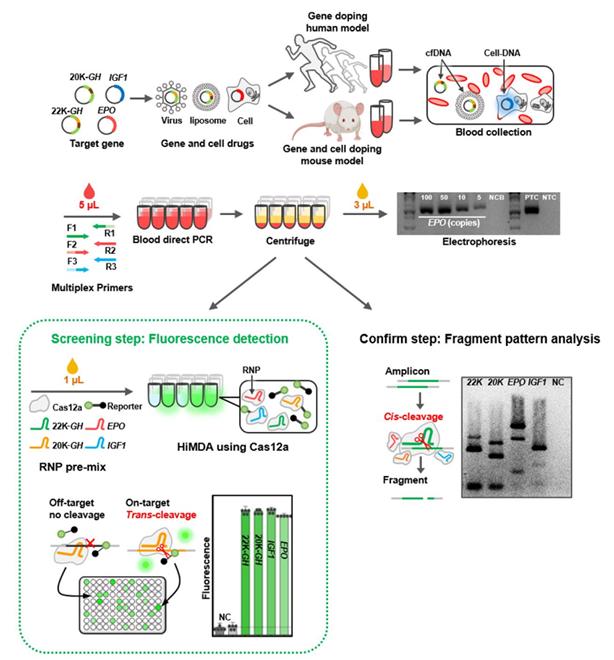
△ A schematic illustrating the overall flow of the HiMDA platform that integrates the CRISPR-Cas12a system and blood direct PCR for simultaneous high-sensitivity gene and cell doping analysis. With only a small amount of blood (5 μl), amplification of multiple target genes is possible without DNA extraction, and the results are quantitatively analyzed as fluorescent signals. This schematic diagram shows at a glance the major technical advantages of HiMDA, such as fast analysis speed (within 90 minutes), high sensitivity (at the level of 2.5 copies), and multiplexing (simultaneous analysis of four genes).
Professor Park Hee-ho’s group from the Division of Biotechnology at KU (President: Kim Dong-one) conducted a joint study with Dr. Sung Chang-min’s group from the Korea Institute of Science and Technology (KIST; President: Oh Sang-rok) as well as research groups from Kookmin University and Seoul National University in order to develop a high-sensitivity gene and cell doping analysis technology called High-throughput Multiplexed gene and cell Doping Analysis (HiMDA). Through this, the research team has overcome the limitations of existing protein-based analyses and suggested the potential of next-generation integrated surveillance technology.
The results of this study were published online on July 9, 2025 in Science Advances (IF=12.5, JCR top 8.5%), a globally renowned SCIE-level journal in multidisciplinary sciences.
*Article Title: High-throughput multiplexed gene and cell doping analysis through CRISPR-Cas12a system integrated with blood direct PCR
*DOI: 10.1126/sciadv.adv7234
*URL: https://www.science.org/doi/10.1126/sciadv.adv7234
With the recent development of gene and cell therapy technologies, so-called “gene and cell doping,” which aims to enhance athletic performance, is threatening the sports community. The World Anti-Doping Agency (WADA) published its 2021 gene doping analysis guidelines, but the proteins expressed by doping genes are structurally identical to endogenous proteins, and therefore it is difficult to detect them using existing protein-based analysis methods, and such detection takes a long time. Accordingly, the need for an analytical platform that enables detection at the gene level has become obvious.
*Endogenous proteins: Proteins that are naturally produced in the body
Therefore, the joint research team developed a HiMDA platform that combines blood direct PCR technology, which enables direct amplification of doping genes in blood without separately extracting DNA, and the CRISPR-Cas12a system, which recognizes target genes and detects them with the use of fluorescence. In particular, they increased the analytical reliability of their research by applying a double verification procedure based on gene fragment patterns.
*Gene fragment pattern: A unique fragment pattern that occurs when a gene is cleaved by a specific enzyme
In particular, the joint research team directly injected plasmids loaded with doping genes and doped cells into laboratory animals to establish an in vivo doping situation in order to confirm how gene and cell doping occurs in an actual biological environment. This study is academically significant because, unlike previous doping analyses that were conducted at the protein level, an in vivo doping model was implemented, and furthermore a detection experiment was carried out.
*Plasmid: A circular DNA molecule carrier used for gene transfer and e-x-p-r-e-s-s-i-o-n
Furthermore, by utilizing this in vivo doping model, the joint research team simultaneously detected four types of doping genes within 90 minutes using only 5 microliters (μL) of blood, and demonstrated that doping genes can be detected up to 84 hours after their injection into the body. The new technology exhibited a sensitivity that is more than four times higher than that of existing analysis methods, and proved that it is a highly effective technology that can be applied to long-term tracking, precision analysis, and multi-target surveillance. The platform is expected to contribute to the monitoring of the misuse of gene and cell therapy technologies, and the establishment of new international anti-doping standards in the future.
KU Professor Park Hee-ho said, “This study is an experimental demonstration that gene/cell-based doping can be implemented in vivo and detected with high sensitivity. Our results are significant in that the new technology goes beyond the existing protein-centered doping monitoring system and presents new analysis criteria in response to evolving gene/cell-based doping scenarios.” Professor Park also said, “Since we verified both the reality of doping scenarios and the applicability of the analysis technology, in the future our technology can be extended to various fields such as monitoring unintentional gene/cell-based doping use and long-term tracking analysis.”
The study was supported by the Basic Research Lab program funded by the Ministry of Science and ICT and the National Research Foundation of Korea, the High Value-added Food Technology Development Program funded by the Ministry of Agriculture, Food and Rural Affairs, and the Substitute Seaweed Meat and Cultured Fish Meat Development Program funded by the Ministry of Oceans and Fisheries.
[Figure]