KU Undergraduate Publishes First-Author Paper in a Globally Renowned Journal: Real-Time Observation of How a Lower-Mantle Mineral Forms
- categorization Research
- writing date 2026.09.09
- author Communication Team
- hits 66
KU Undergraduate Publishes First-Author Paper in a Globally Renowned Journal: Real-Time Observation of How a Lower-Mantle Mineral Forms
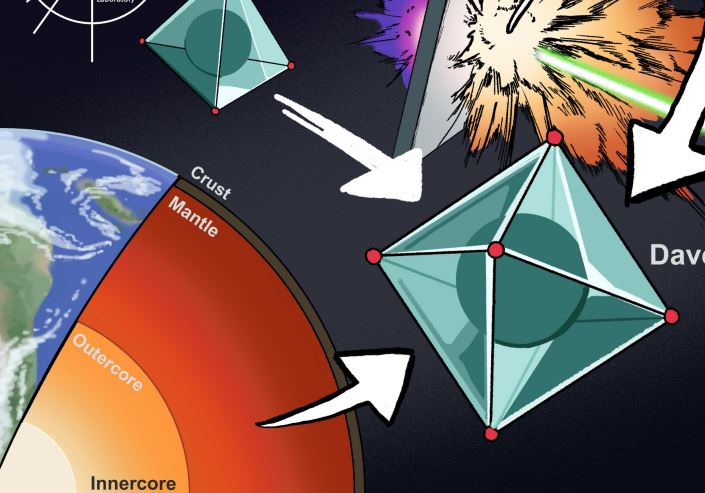
△ Image depicting the transformation process in which wollastonite (CaSiO3) is instantaneously compressed by a powerful laser-driven shock wave, causing the atomic structure around the silicon to be rearranged from a tetrahedral to a denser octahedral coordination, thus forming davemaoite (CaSiO3-perovskite), a major mineral within Earth’s deep mantle.
Taking one step closer to unraveling the mysteries of planetary formation and evolution, a research team led by Professor Kim Dong-hoon of the Department of Earth and Environmental Sciences at Korea University (President Kim Dong-One) has successfully observed in real time how davemaoite, a major mineral within Earth’s lower mantle, forms under extreme shock conditions.
*Davemaoite: A calcium silicate (CaSiO3) mineral found in Earth’s lower mantle that is stable only under high pressure.
Lee Mu-jin (a 2024 entrant), an undergraduate researcher in the Department of Earth and Environmental Sciences at KU, led the study and published it as first author in the international journal Nature Communications. This is a significant result achieved by an undergraduate student taking part in large-scale international collaborative research at a world-class research facility and reflects KU’s research-centered education and its systematic mentoring system.
In extreme environments such as meteorite impacts, very high pressures and temperatures are generated in an instant, and the structure of minerals can change rapidly in the process. Because these changes occur within nanoseconds (i.e., a billionth of a second), it has been difficult until now to observe the process directly.
Using SACLA, Japan’s state-of-the-art X-ray free-electron laser (XFEL) facility, the team succeeded in directly observing in real time how calcium silicate (CaSiO3) transforms into davemaoite under extreme shock conditions.
*XFEL: A next-generation X-ray source produced using a large electron accelerator. It generates X-ray pulses that are far brighter and much shorter than those of conventional synchrotron light sources, making it possible to observe ultrafast changes in materials at the atomic level in real time.
By directly observing the transformation of calcium silicate into davemaoite during shock compression, the team uncovered an important clue for understanding how lower-mantle minerals form under extreme conditions. The work also presented a new experimental approach for studying how the interior materials of both Earth and other rocky planets change when they undergo strong impacts.
*Shock compression: A process in which a strong shock wave is applied to a material to compress it instantaneously, reproducing the extreme pressures and temperatures found deep inside Earth or in meteorite impacts.
Professor Kim Dong-hoon said, “In this study, we directly confirmed, in real time, how davemaoite, a mineral found deep inside Earth, forms under extreme pressure, and our results provide an important clue for understanding the interiors of Earth and of rocky exoplanets. We will continue to develop a research environment in which students can grow into global researchers by actively taking part in international collaborations at world-class research facilities.”
The results were published online on August 27, 2026, in Nature Communications (IF=18.1), an international multidisciplinary journal.
*Article title: Direct observation of shock-induced formation of davemaoite, Ca-perovskite
*DOI: 10.1038/s41467-026-76624-y
*URL: https://www.nature.com/articles/s41467-026-76624-y
This research was supported by the Ministry of Science and ICT, the National Research Foundation of Korea, and Korea University. The international collaboration for this research was centered on KU, with researchers joining from the Carnegie Institution for Science (USA), Tohoku University (Japan), Osaka University (Japan), the Japan Synchrotron Radiation Research Institute (JASRI), Chonnam National University, the Gwangju Institute of Science and Technology (GIST), Pusan National University, and the Pohang Accelerator Laboratory (PAL).
[Research group photo]